Which Collar Fits Custom Aloha Shirts?
· Development · Aloha and Co
Current Kahala, Patagonia, and Reyn Spooner product pages show several aloha-shirt collar routes. Buyers should choose one before sample approval.
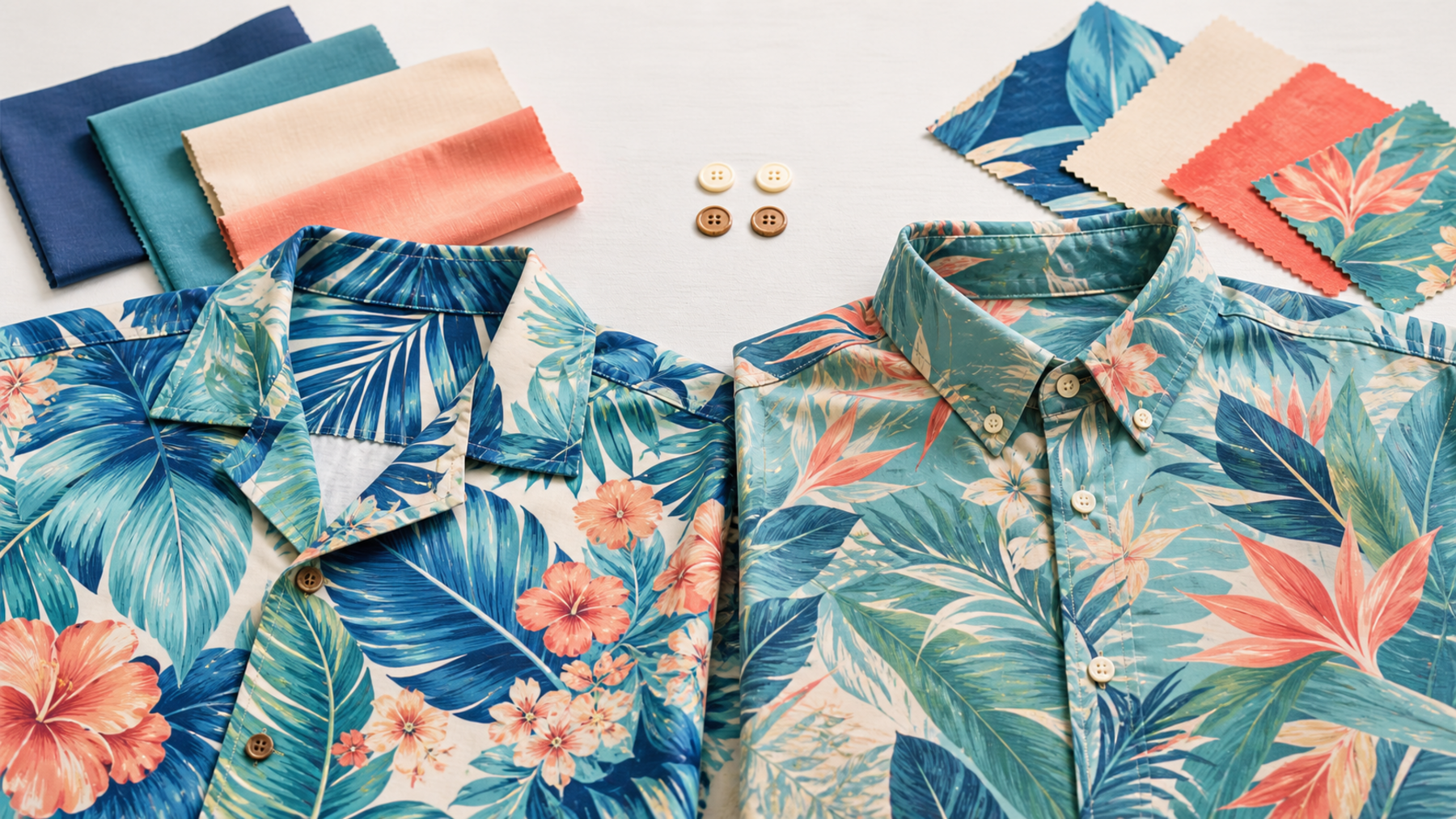
Summary. Current product pages from Kahala, Patagonia, and Reyn Spooner show button-down, notched, turned-down, and camp collar routes. Custom aloha shirt buyers should choose the retail role first, then lock the collar and shirt block before bulk.
Key Takeaways
- Current Kahala, Patagonia, Reyn Spooner, and custom-shirt pages show that aloha shirts use several distinct collar routes.
- The collar route should be chosen with the intended retail setting and shirt block before artwork and sample approval.
- A collar brief should identify the collar type, neckline, front opening, top closure, fabric, fit, artwork, pocket, and size range.
- Bulk inspection needs an agreed specification and sample reference; a tolerance published by one shirtmaker is not a universal standard.
Direct Answer
Custom aloha shirts should use the collar route that matches the intended retail setting and approved shirt block. Buyers should choose camp, notched, point, or button-down before artwork sign-off, then record the neckline, front opening, fabric, collar proportions, top closure, measurements, and sample photos for bulk reference.
Current Aloha Shirts Use Several Collar Routes
Current product pages show that an aloha shirt does not come with one default collar. Kahala's E Kipa Mai, released for its 2026 anniversary collection, uses a longer vintage-inspired button-down collar. Its current Paniolo Country shirt also lists a button-down collar. Patagonia's current Pataloha shirt specifies a notched collar, while its Malihini Pataloha uses a turned-down collar.
Reyn Spooner's current fit guide separates traditional button-down shirt fits from a camp rayon fit, and a current custom aloha shirt product page offers point or camp collar choices. Each route creates a different sample brief, so buyers should choose the collar before a factory builds the sample.
Choose the Collar by the Shirt's Retail Role
Start with the intended presentation. If the brief calls for an open resort neckline, a camp or notched route gives the sample team a clear direction. If the brief calls for visible collar points, a turned-down, point, or button-down route gives the team a different opening and closure to build. These are development choices, not universal rules about where a shirt may be worn.
The buyer should send one visual reference and one written collar name, then connect that choice to the fit block, fabric hand, front opening, top closure, hem, pocket, and artwork. Avoid approving a generic collar sketch separately from the shirt. The finished sample needs to show how the collar sits on the selected body and fabric.
Put the Collar Route in the Sample Brief
A useful collar brief identifies the route, neckline, front opening, facing or placket direction, top-button or loop decision, point or notch proportions, and any collar-point buttons. It also names the fabric, shirt measurements, fit direction, pocket treatment, artwork placement, labels, ordered size range, and the views required for approval.
Ask the sample team to photograph the shirt from the front, side, and back, then show the collar open and closed where the design allows both. Review whether the collar sits evenly, whether the opening matches the approved reference, and whether the print or pocket treatment remains balanced around the upper body.
Carry One Approved Collar Reference Into Bulk
Intertek describes textile and apparel inspection across pre-production, during production, inline, and before-delivery stages. Its workmanship assessment covers construction, attachments, fasteners, and pattern continuity or matching. For custom aloha shirts, the buyer's approved sample and written collar specification give those checks a defined target.
Measurement tolerances should be agreed for the selected product rather than copied without review. Proper Cloth publishes one collar-around tolerance for its own garments, which is useful as an example of a written range but not a universal aloha-shirt standard. Record the measurement point, accepted range, visual reference, and correction decision before bulk approval.
Aloha Shirt Collar Route Comparison
| Collar route | Current product-page signal | Buyer decision | Sample proof |
|---|---|---|---|
| Camp collar | A current custom-shirt product page offers a camp collar choice. | Use when the brief calls for an open collar presentation, then define the full shirt block around it. | Open and closed front views, neckline shape, collar spread, facing, and top-closure decision. |
| Notched collar | Patagonia's current Pataloha shirt specifies a notched collar. | Treat the notch and opening as visible design features rather than generic factory defaults. | Notch balance, collar roll, front opening, print placement, and left-right symmetry. |
| Point or turned-down collar | A current custom-shirt page offers a point collar, while Patagonia's Malihini Pataloha lists a turned-down collar. | Define the point length, opening, and fit block so the sample matches the intended presentation. | Point shape, collar fall, neckline, top-button stance, and proportions across the ordered size range. |
| Button-down collar | Kahala's 2026 anniversary shirt and current Paniolo Country shirt specify button-down collars; Reyn Spooner's guide also identifies button-down fit routes. | Specify collar-point buttons and the buttoned or unbuttoned presentation expected at approval. | Point-button placement, collar balance, front view, measurements, and approved bulk reference. |
Buyer Questions
Which collar route should custom aloha shirts use?
Choose the route that fits the intended retail setting and shirt block. A camp or notched collar supports an open presentation, while point, turned-down, and button-down routes give buyers a different collar shape to define and approve.
Should buyers choose the collar before approving artwork?
Yes. Collar shape and opening change which parts of the print appear near the neckline, front edge, pocket, and upper chest. Approve artwork placement on the selected shirt block.
What belongs in an aloha shirt collar brief?
Name the collar route, reference image, neckline, front opening, top closure, fabric, fit block, point or notch proportions, artwork rules, pocket, labels, size range, and sample-photo list.
What should buyers inspect on the collar sample?
Review front, side, back, open, and closed views. Check collar balance, neckline, point or notch shape, roll or stand, top closure, print placement, measurements, and the approved reference for bulk.
Can a supplier's standard collar tolerance be reused?
Do not assume it applies. Proper Cloth publishes one maker-specific collar-around tolerance, which shows why buyers and suppliers should agree on the measurement point and accepted range for the selected shirt.
Does a low-MOQ aloha shirt order need a collar sample?
A small first run still needs one defined collar route and approval reference. Keeping the first order to one shirt block, collar, fabric, and artwork direction gives the buyer a clearer bulk comparison.