Custom Aloha Shirt Price vs Quality Checklist
· Development · Aloha & Co Editorial Team
Compare aloha shirt quotes through fabric feel, fit, wrinkle recovery, seam strength, origin labels, and sample controls—not price alone.
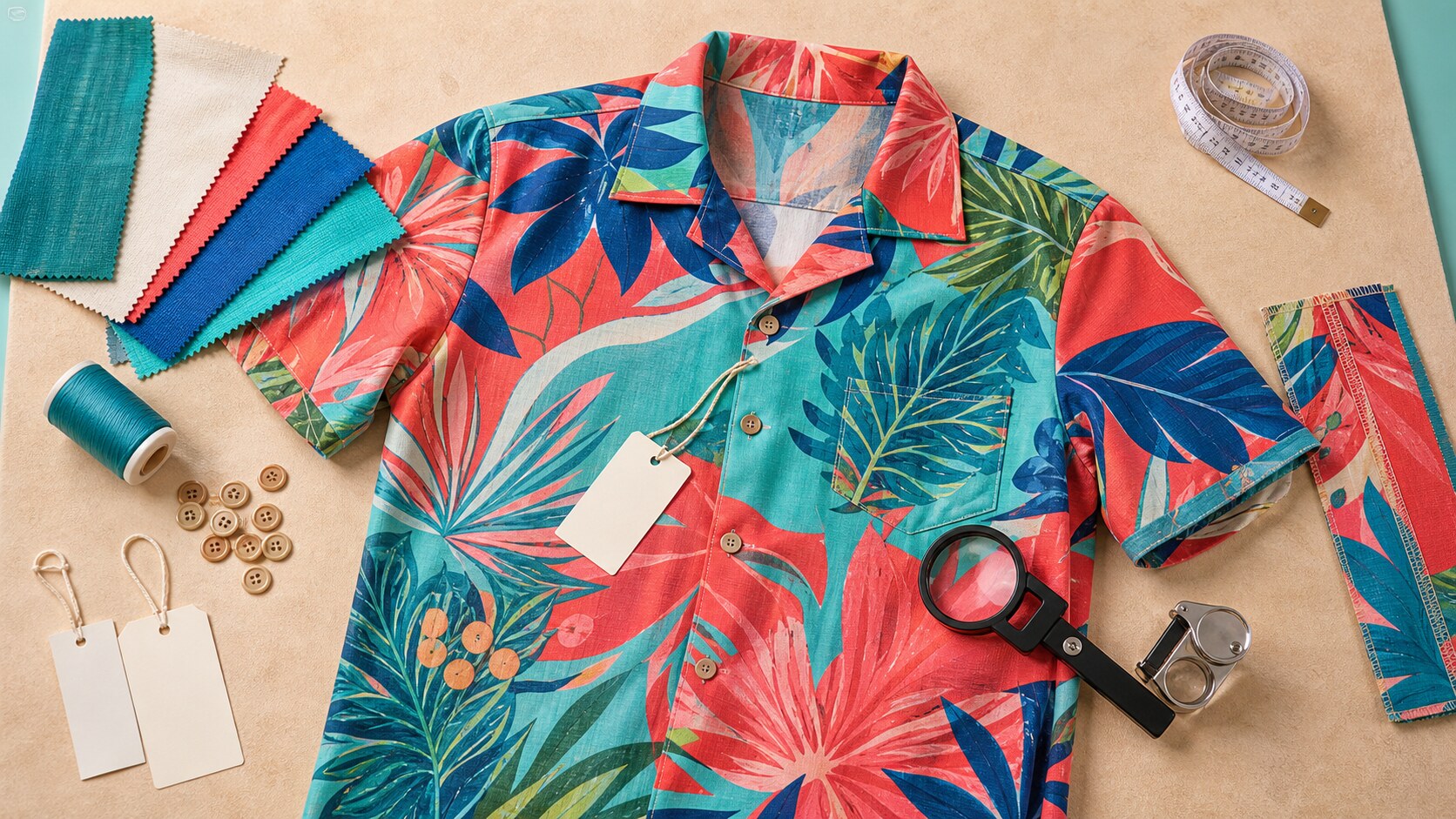
Summary. Buyer discussions compare shirts near $50 with options above $100 through feel, fit, durability, labels, and care. A useful sourcing checklist converts those cues into defined specifications, named tests, documented tolerances, and approvals.
Key Takeaways
- Compare quotes against one specification; no trustworthy universal price tier tied to fabric, construction, MOQ, printing, trims, testing, freight, duties, or geography was visible.
- Turn hand feel, wrinkles, and wash stability into named checks such as AATCC TM202 or TM218, TM128, TM124, and TM150.
- Define a target body profile, garment measurements, measurement methods, and point-specific tolerances before approving fit.
- Keep sample approval separate from bulk inspection, and verify origin claims in garment labels and online product copy.
Direct Answer
A custom aloha shirt price vs quality checklist should compare identical, written specifications for fabric hand, fit, wrinkle recovery, wash stability, seam integrity, origin labeling, and sample approval. Do not assign quality from price alone: define an acceptance method for each cue, then compare quotes against the same requirements and production-inspection plan.
Set the Tier with Comparable Specifications
Buyer discussions mention shirts around $50 versus $100+, markdowns to $50 or less, and secondhand finds at $10–$20. These price anecdotes and market observations cannot establish a universal production price tier or prove that a fiber, brand, or price delivers a predictable result. Do not use secondhand or markdown prices as production benchmarks. No trustworthy universal custom-shirt price band tied to fabric, construction, MOQ, print method, trims, packaging, compliance testing, freight, duties, or supplier geography was visible in the evidence pack.
Build each quote around one product definition. Record fabric composition and weight, print route, fit block, size range, seams, buttons, labels, packaging, testing, order quantity, and delivery basis. Mark every difference and price it separately. A cheaper quote is comparable only when the supplier accepts the same requirements.
Replace Soft Hand with an Approval Method
Specify the selected composition, construction, finish, weight, color or print, and approved physical swatch for each quote.
AATCC lists two instrumental routes for tactile evaluation: TM202, Relative Hand Value of Textiles, and TM218, Determination of Tactile Sensations of Textiles using an instrumental multi-module method. A buyer may also use a controlled panel review, provided the brand documents conditioning, reference swatch, evaluators, attributes, and acceptance decision. No universal acceptable hand score for custom aloha shirts was found. Set the method and threshold before asking an aloha shirt manufacturer to reproduce the hand.
Test Wrinkles, Washing, and Fit
Replace wrinkle-resistant with the result you need. AATCC TM128 covers fabric wrinkle recovery by appearance. TM124 covers smoothness appearance after home laundering, while TM150 covers garment dimensional change after home laundering. State the laundering cycle, number of cycles, evaluation point, and buyer-defined acceptance grade or dimensional tolerance in the test request. The evidence pack provides no universal wrinkle grade or shrinkage limit for all custom aloha shirts.
Fit also needs a defined reference. ISO 8559-1:2017 supplies anthropometric definitions for body measurement. Use a target body profile, then create finished-garment measurements and a stated measurement method. Set tolerances at each point rather than applying an invented blanket number. Approve fit on the intended block and size range, not from a size label or price tier.
Check Seam Integrity with the Right Caveat
Construction durability starts with written workmanship criteria: seam type, stitch type, reinforcement points, button attachment, matching requirements, and defect limits. ASTM D1683-07 measures sewn-seam strength in woven apparel fabrics by applying force perpendicular to the seam.
Use the test to compare a specified seam and fabric combination, then retain the specimen details and result. ASTM states that the method does not predict actual wear performance. Do not turn one seam result or a buyer's report that a shirt lasted for years into a service-life promise. No universal seam-strength value or stitch density for every Hawaiian shirt manufacturer was visible.
Verify Origin Claims at Every Touchpoint
Treat origin wording as a compliance field, not a price-tier flourish. The FTC says an unqualified Made in USA claim requires a product to be all or virtually all made in the United States. For most clothing, a Made in USA label is required when both the final product and the fabric are manufactured in the United States. Textile products involving domestic and foreign processing must disclose both.
Online promotional materials must disclose whether the textile product is U.S.-made, imported, or both. Check purchase-order wording, sewn labels, packaging, product pages, and wholesale copy against the production record. The evidence pack does not establish Hawaii-specific thresholds for Made in Hawaii claims, so obtain appropriate local guidance before using that wording.
Separate Sample Approval from Bulk Control
Freeze the specification before approving the sample. QIMA divides apparel quality control into documentation and standards, inspection protocols, and testing. Its checklist examples cover product dimensions, packaging, and on-site tests.
Create an approval record with sample version, fabric and trim references, measured results, test reports, deviations, decision, approver, and date. Then issue the approved specification and inspection checklist with the purchase order. An approved pre-production sample alone does not guarantee bulk conformity. Define which production stages and quantities will be inspected; a universal sampling plan is not visible in the evidence pack.
Use the same grid for every supplier quote and record exclusions rather than filling gaps with assumptions. Buyers can browse aloha shirt base styles and contact Aloha & Co for a specification discussion. Published by Aloha & Co, a resort wear, swimwear, and aloha shirt manufacturer.
Buyer Comparison
| Quality cue | Buyer specification | Evidence-based check |
|---|---|---|
| Hand feel | Composition, construction, finish, approved swatch | AATCC TM202 or TM218, or documented panel |
| Wrinkle and care | Laundry cycle and buyer-defined acceptance | AATCC TM128, TM124, and TM150 |
| Fit | Target body, garment chart, method, tolerances | ISO 8559-1 body definitions plus sample measurements |
| Seam durability | Seam and stitch specification | ASTM D1683-07 with wear-performance caveat |
| Origin | Production record, label, packaging, online copy | FTC Made in USA and textile-origin guidance |
| Bulk conformity | Approved sample, tolerances, inspection plan | QIMA documentation, inspection, and testing controls |
Buyer Questions
Is $50 a reliable quality tier for an aloha shirt?
No universal price tier was visible. Public replies mention shirts around $50 and used purchases below that level, but those experiences do not control fabric, construction, fit, care, or durability.
How should buyers specify fabric hand feel?
Define composition, construction, finish, weight, and an approved swatch. Request AATCC TM202 or TM218, or document a controlled panel method and buyer-defined acceptance threshold.
Which tests address wrinkles and laundering?
AATCC TM128 covers wrinkle recovery appearance, TM124 covers smoothness after home laundering, and TM150 covers garment dimensional change after home laundering. Buyers must define acceptance levels.
Does ASTM D1683 prove how long a shirt will last?
No. ASTM D1683-07 measures selected sewn-seam properties, but the standard says it does not predict actual seam wear performance.
What should buyers approve before bulk production?
Approve the specification, measurement methods, tolerances, physical fabric and trims, artwork, sample version, test results, deviations, and inspection plan. Keep bulk inspection separate from sample approval.
Sources
- https://www.reddit.com/r/VisitingHawaii/comments/1v5ml33/best_midprice_aloha_shirt_brands/
- https://www.reddit.com/r/FrugalHeritageWear/comments/1vb9u85/budget_aloha_shirts/
- https://www.aatcc.org/testing/standards
- https://store.astm.org/standards/d1683
- https://www.ftc.gov/business-guidance/resources/complying-made-usa-standard
- https://www.iso.org/standard/61686.html
- https://www.qima.com/blog/apparel/apparel-quality-control-procedures