Custom Hawaiian Shirt Polyester Handfeel Checklist
· Development · Aloha & Co Editorial Team
Approve polyester Hawaiian shirt samples by checking sheen, tactile feel, airflow, odor claims, and dimensional recovery under repeatable conditions.
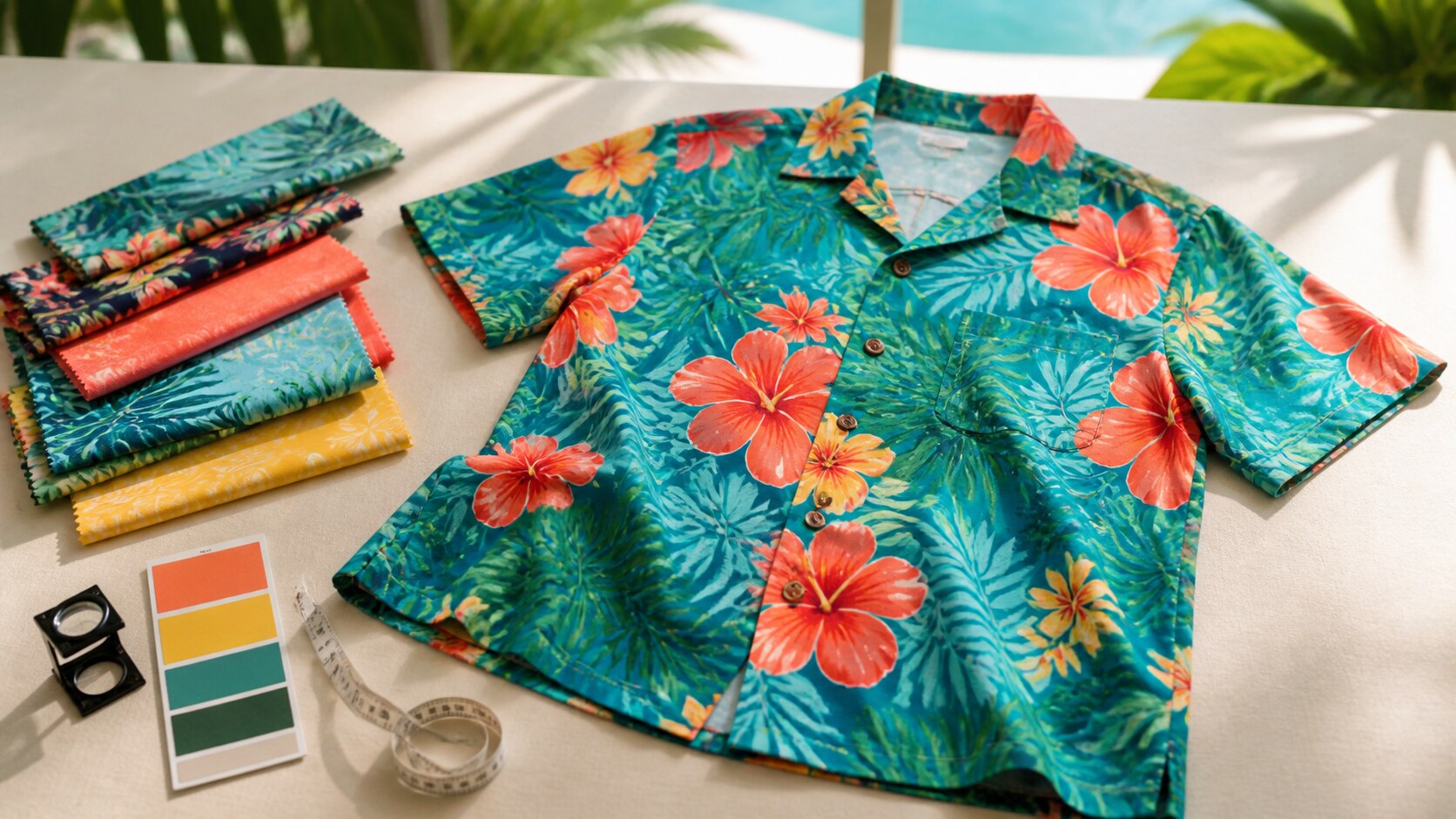
Summary. Buyer objections to a $73 polyester shirt included plastic-like sheen and feel, heat, breathability, odor, and fit. Buyers can turn those objections into documented sample tests before bulk production.
Key Takeaways
- Approve sheen against a physical control under agreed lighting because no universal plastic-sheen threshold was visible.
- Use AATCC TM218-2025 to replace vague plastic-like or costume-like labels with comparable tactile properties.
- Compare sample and bulk airflow with ASTM D737-18(2023); no universal comfort value for Hawaiian shirts was visible.
- Test odor claims on the finished fabric and measure garment length and width after laundering with AATCC TM150-2025.
Direct Answer
A custom Hawaiian shirt polyester handfeel checklist should record visual sheen, tactile response, air permeability, substantiated odor performance, and dimensional change after laundering. Approve a physical control sample under agreed conditions, set style-specific tolerances in writing, and require bulk fabric and garments to match it before cutting or shipment.
Turn buyer objections into approval fields
The custom Hawaiian shirt polyester handfeel checklist starts with observable objections, then assigns each one a sample, condition, test method, and acceptance decision. Buyers have described shirts as heavier, hotter, less breathable, and more plastic-like than expected. These objections do not prove that all polyester performs the same way. Put five rows on the sample sheet: sheen, touch, airflow, odor claim, and shape after laundering. Add the control sample ID, inspection conditions, test reference, tolerance, result, approver, and date. If a pass/fail number is unsupported, define a contractual visual or physical comparison instead.
Approve sheen and handfeel with a physical control
Inspect the sample face and back under agreed lighting. Record light type, viewing distance, colorway, and whether the fabric is flat or worn. Photograph the setup, but retain the signed physical sample as the visual control. No trustworthy universal threshold for acceptable plastic sheen on printed polyester Hawaiian shirts was visible, so the buyer and supplier must agree what passes. Handle the collar, placket, body, sleeve, and seam intersections. Record surface friction, stiffness, bending response, compression, and recovery against the control. AATCC TM218-2025 determines fabric properties that create tactile sensations during skin contact. Ask the lab or supplier which reported modules fit the fabric. With no universal numeric limits for "plastic-like" or "costume-like" feel, connect selected measurements to the approved control.
Compare airflow before bulk cutting
A wear trial can reveal an obvious problem, but it does not give the supplier a repeatable bulk criterion. ASTM D737-18(2023) measures textile-fabric air permeability and applies to woven, nonwoven, knitted, layered, napped, and pile fabrics. Request sample and bulk-fabric results under the same conditions. Identify the fabric lot and colorway, and set a control-relative tolerance before the purchase order becomes binding. No universal ASTM D737 value guarantees hot-weather comfort for this category. Combine the comparison with a documented wear evaluation using the intended fit, undershirt condition, temperature range, and trial duration.
Test the finished fabric for odor claims
Do not approve an anti-odor or deodorant statement from the fiber name alone. ISO 17299-1:2014 gives the general principle for determining textile deodorant property and applies to many textile forms. Ask which procedure supports the supplier's exact claim, then retain the report for the finished fabric. A 2025 study also cautions against fiber-name assumptions. For the tested semi-volatile organic compounds, nylon/elastane partition coefficients were about 7-70 times higher than jeans cotton, while jeans-cotton values were about 2-7 times higher than polyester. These compound- and textile-specific results do not establish a universal odor ranking. No universal pass/fail limit for untreated polyester Hawaiian shirts was visible.
Measure shape recovery after home laundering
Mark garment measurement points before washing. At minimum, record body length and width at named locations on the approved sample. Add style-specific checks such as sleeve opening, collar shape, placket alignment, side-seam twist, print placement, and overall fit where the buyer's specification requires them. AATCC TM150-2025 measures dimensional changes in garment length and width after home laundering. It includes four washing temperatures, three agitation cycles, and four drying procedures and is related to ISO 3759. Choose the procedure that matches the proposed care label, record the starting dimensions, complete the agreed number of cycles, condition the garment as required by the test plan, and record the final dimensions and fit observations. No universal allowable shrinkage, growth, skew, or seam-twist tolerance specifically for custom polyester Hawaiian shirts was visible. The buyer must state those limits in the style specification and purchase agreement before bulk approval.
Lock the approval record into the purchase order
Give the aloha shirt manufacturer one controlled approval pack. Include the sealed garment sample, fabric or bulk-lot reference, colorway, print version, lighting setup, AATCC TM218 tactile results when used, ASTM D737 air-permeability results, odor-claim substantiation when claimed, and AATCC TM150 dimensional-change results. Name the laboratory or responsible party, test date, method edition, care procedure, and pass criteria. Separate three outcomes: approved, approved with written correction, and rejected. A correction note should identify the field that changes and require a new approval where the change can affect touch, airflow, odor treatment, or dimensions. Production should use the same documented criteria for incoming bulk fabric and finished-garment checks. The first internal resource links to the relevant aloha shirt manufacturer page; the remaining links provide company context and base-style references. Published by Aloha & Co, a resort wear, swimwear, and aloha shirt manufacturer.
Buyer Comparison
| Approval field | Evidence-based method | Buyer decision |
|---|---|---|
| Plastic sheen | Physical control under agreed lighting | Define visual pass standard; universal threshold not visible |
| Handfeel | AATCC TM218-2025 plus control sample | Agree tactile properties and limits |
| Hot-weather airflow | ASTM D737-18(2023) | Compare sample and bulk; universal comfort value not visible |
| Odor claim | ISO 17299 framework on finished fabric | Require claim-specific substantiation |
| Wash-related fit | AATCC TM150-2025 | Set style and care-label tolerances |
Buyer Questions
What belongs on a polyester Hawaiian shirt handfeel checklist?
Record sheen, tactile properties, airflow, odor-claim evidence, and dimensional change. For each field, name the control sample, conditions, method, tolerance, result, and approver.
Is there a universal limit for plastic-like polyester handfeel?
No trustworthy universal numeric limit was visible. Approve a physical control sample and use an agreed tactile method such as AATCC TM218-2025 for supplier-comparable measurements.
What ASTM D737 value guarantees a cool Hawaiian shirt?
No universal minimum guaranteeing hot-weather comfort for this category was visible. Compare the approved sample with bulk fabric under the same conditions and pair the result with a defined wear trial.
Can buyers infer odor retention from polyester content?
No. The cited 2025 study found textile and compound-specific sorption results. Test the actual finished fabric and require ISO 17299-based substantiation for any deodorant claim.
How should buyers check fit after laundering?
Use the AATCC TM150-2025 procedure selected for the care label, measure length and width before and after laundering, and apply contractually agreed style tolerances.
Sources
- Hawaiian Shirt
- ASTM D737-18(2023) Standard Test Method for Air Permeability of Textile Fabrics
- AATCC TM218-2025 Determination of Tactile Sensations of Textiles
- AATCC TM150-2025 Dimensional Changes of Garments after Home Laundering
- ISO 17299-1:2014 Textiles Determination of Deodorant Property
- Sorption of Semi-Volatile Organic Compounds to Clothing Textiles