Custom Hawaiian Shirt Rayon vs Cotton Fabric
· Development · Aloha & Co Editorial Team
Compare drape, weight, cotton preparation, shrinkage, crocking, fabric hand, and wash performance before approving a custom Hawaiian shirt fabric.
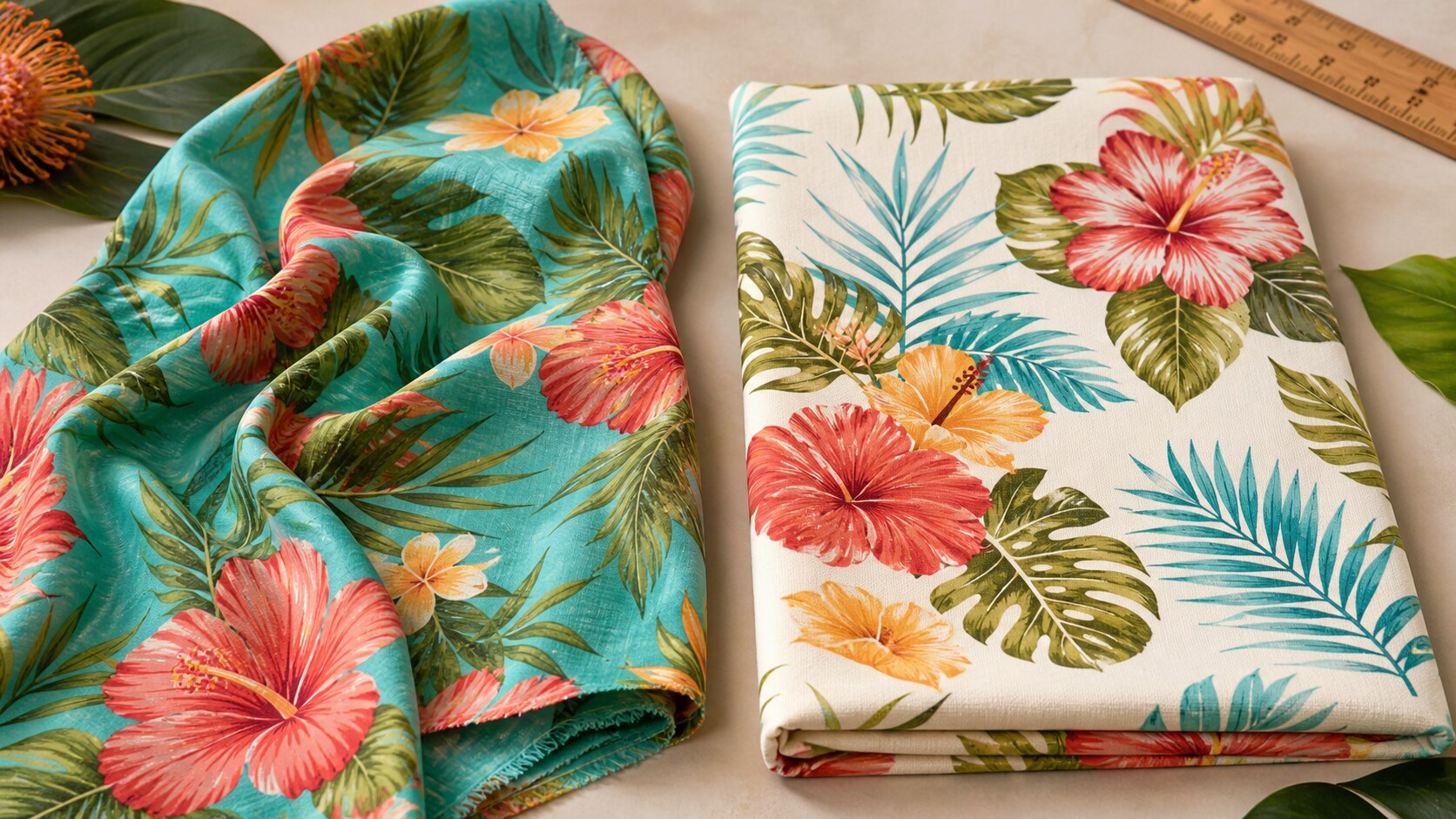
Summary. For custom Hawaiian shirt rayon vs cotton fabric, compare a real rayon sample against the specified cotton substrate. Approve drape, hand, print, shrinkage, crocking, and laundering against written criteria rather than choosing by fiber name.
Key Takeaways
- Cotton lawn is specified at 2.4 oz/yd² (81 gsm), while organic cotton sateen is 3.8 oz/yd² (130 gsm); those weights will not produce the same shirt structure.
- Cotton preparation affects print results: CottonWorks says scouring and bleaching are minimum steps, while mercerization can improve dye uptake, luster, brightness, and fastness.
- Request substrate-specific evidence. The cited cotton lawn lists dry and wet crocking ratings of 4 on a 1-to-5 scale under AATCC TM 8.
- Rayon suggestions in the public discussion are buyer opinions. The pack contains no tied supplier specification or matched rayon-versus-cotton performance dataset.
Direct Answer
For custom Hawaiian shirt rayon vs cotton fabric, approve the actual printed and washed substrates, not a fiber name alone. Compare drape, fabric hand, weight, print appearance, dimensional change, crocking, and care performance against written program-specific limits; the evidence pack provides no matched rayon-versus-cotton test or universal pass thresholds.
Start With The Actual Substrate
For custom Hawaiian shirt rayon vs cotton fabric, the first decision is not rayon or cotton in the abstract. It is the exact substrate, print process, finish, and care route that will be purchased. A March 17, 2026 public question asked for a custom Hawaiian-shirt fabric suited to the garment while retaining bright color. Five visible top-level replies suggested cotton sateen, rayon challis, lightweight rayon, lightweight linen, cotton lawn, linen-rayon blends, and polyester crepe de chine. Those replies identify options to sample, not verified performance rankings.
Ask the Hawaiian shirt manufacturer to identify the exact rayon and cotton constructions before comparing strike-offs or garments.
Compare Weight, Drape, And Opacity
Two cotton choices from the same supplier show why fiber labels are too broad. Cotton lawn is 100% cotton, 54 inches (137 cm) wide, and 2.4 oz/yd² (81 gsm). Organic cotton sateen is 100% organic cotton, 56 inches (142 cm) wide, and 3.8 oz/yd² (130 gsm). The supplier states a weight tolerance of plus or minus 5%. Its product page further describes the lawn as semi-opaque, plain weave, and a 268-count construction.
Specify Cotton Print Preparation
Bright artwork cannot be approved from an on-screen image. CottonWorks reports that as many as 60% of textile printing defects can be traced to preparation problems. It identifies scouring and bleaching as the minimum cotton preparation sequence. It also says mercerization improves smoothness, dimensional stability, strength, dye uptake, and luster, and that mercerized cotton prints typically show maximum color brightness and improved color fastness.
For cotton, the purchase specification should therefore state more than composition and weight. Ask whether the base is scoured, bleached, or mercerized; identify the print method and finish; and approve a strike-off on the production substrate. For rayon, request the equivalent supplier preparation and print-process details. The pack supplies no comparable rayon preparation data, so do not promise that rayon will be brighter, duller, softer, or more colorfast than cotton.
Approve Shrinkage And Color Transfer
Supplier estimates establish a starting point for cotton sampling. Cotton lawn lists estimated shrinkage of 0-3% in length and 1-2% in width. Organic cotton sateen lists 1-4% in length and 3-4% in width. By comparison, the supplier's poly crepe de chine is 1.9 oz/yd² (65 gsm) with estimated shrinkage of 0-1% by 1-2%, while Essex Linen is 5.5 oz/yd² (186 gsm) with 4-6% by 2%. These are distinct substrates, not a controlled fiber comparison.
Translate percentages into garment checks. Measure the fabric or shirt before and after the agreed care cycle, then review length, chest, collar, placket alignment, pocket matching, seam distortion, hand, and print appearance. AATCC TM135-2025 covers dimensional changes of fabrics after home laundering, and TM150-2025 covers garments. The test-method reference does not set the buyer's pass limit.
Request color-transfer results for the approved substrate and colorway, especially saturated grounds and high-contrast prints.
Match Testing To The Care Route
The 2026 AATCC manual provides named references for a practical approval plan. Besides TM135-2025 and TM150-2025, AATCC TM204-2025 covers water-vapor transmission and EP5-2025 covers fabric hand. These can support conversations about hot-weather comfort and tactile approval, but the evidence pack contains no head-to-head rayon and cotton results. Buyers must define the method, conditioning, sample count, and acceptance limits with the supplier or laboratory.
ISO 105-C12:2024 covers resistance of textile color to industrial laundering. Do not substitute a home wash review for industrial care performance.
Build The Approval File
Give the aloha shirt manufacturer one comparison sheet for every candidate: supplier article number, fiber content, construction, width, weight and tolerance, opacity, preparation, print method, finish, expected shrinkage, care route, and requested test evidence. Attach the approved artwork scale and color reference, then retain the strike-off, unwashed sample, washed sample, measurements, and comments.
Approve the production substrate that meets the written drape, hand, print, dimensional-change, transfer, and care requirements for the actual shirt.
Buyer Comparison
| Checkpoint | Cotton evidence | Buyer action |
|---|---|---|
| Weight | Lawn: 2.4 oz/yd² (81 gsm); sateen: 3.8 oz/yd² (130 gsm) | Compare production-substrate panels and sewn shirts |
| Shrinkage | Lawn: 0-3% x 1-2%; sateen: 1-4% x 3-4% | Measure fabric and garment after agreed care |
| Print preparation | Scouring and bleaching minimum; mercerization can improve print properties | Specify preparation, print method, and finish |
| Crocking | Cited lawn: dry 4, wet 4 under AATCC TM 8 | Request colorway-specific transfer evidence |
| Hand and comfort | AATCC EP5-2025 and TM204-2025 are available references | Set program-specific methods and limits |
| Rayon comparison | Matched specification and test data: not visible | Sample the named rayon article under the same plan |
Buyer Questions
Is rayon better than cotton for Hawaiian shirts?
The pack does not establish a winner. Compare the exact rayon and cotton articles for drape, hand, print, shrinkage, color transfer, and laundering under one approval plan.
Which cotton is lighter, lawn or sateen?
The cited cotton lawn is 2.4 oz/yd² (81 gsm); the organic cotton sateen is 3.8 oz/yd² (130 gsm). Supplier weight tolerance is plus or minus 5%.
Does cotton automatically print brighter than rayon?
No head-to-head evidence is visible. CottonWorks shows that cotton preparation and mercerization affect dye uptake, luster, brightness, and fastness, so approve production-substrate strike-offs.
What wash tests should buyers request?
Discuss AATCC TM135-2025 for fabric dimensional change and TM150-2025 for garment change. Set program-specific acceptance limits with the supplier or laboratory.
How should commercial-laundry shirts be evaluated?
ISO 105-C12:2024 addresses color resistance to industrial laundering. Do not treat a home wash check as evidence of industrial-laundry performance.
What should the final approval file contain?
Keep the substrate specification, artwork and color reference, strike-off, unwashed and washed samples, measurements, test basis, care route, acceptance limits, and signed comments.
Sources
- https://www.reddit.com/r/sewing/comments/1rw874l/best_spoonflower_fabric_for_a_hawaiian_shirt/
- https://support.spoonflower.com/hc/en-us/articles/360050418771-Fabric-Specifications-and-Details
- https://www.spoonflower.com/en/fabric/11300090?fabric=cotton_lawn_apparel
- https://cottonworks.com/learning-hub/printing/cotton-textile-printing-basics/
- https://www.aatcc.org/news-read/insights/announcing-the-101st-edition-of-the-aatcc-manual-of-international-test-methods-and-procedures
- https://www.iso.org/standard/84808.html