Buyer's Custom Hawaiian Shirt Size Consistency Checklist
· Development · Aloha & Co Editorial Team
A buyer checklist for locking garment measurements, grade rules, tolerances, size-set approval, bulk checks, and repeat-order comparisons.
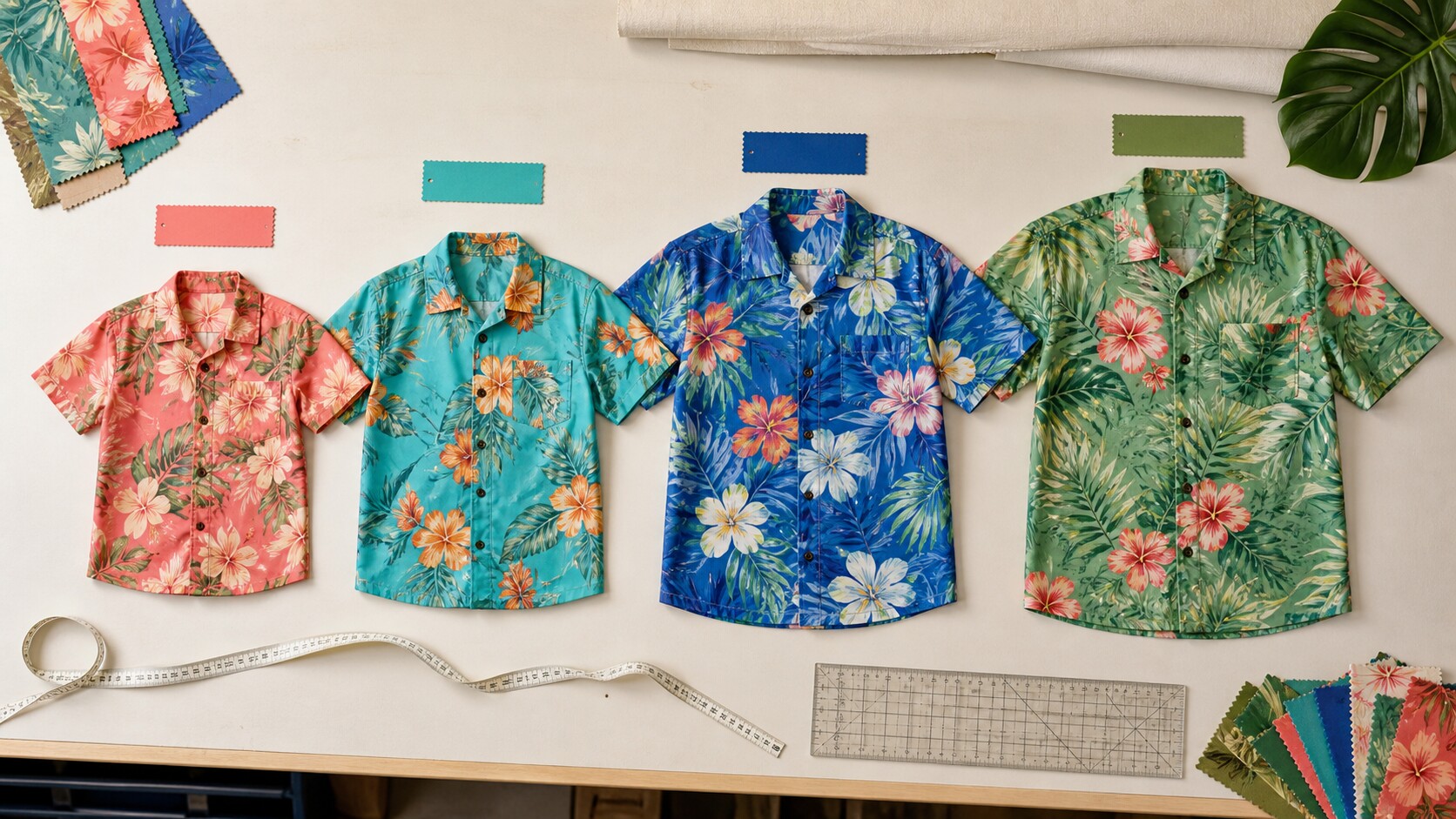
Summary. Buyers should control sizing with finished-garment targets, defined measurement methods, grade rules, point-specific tolerances, representative size-set approval, and bulk and reorder comparisons against an approved sample.
Key Takeaways
- Separate body measurements, finished-garment measurements, and size labels; ISO 8559-1:2017 provides body-measurement definitions and remains current after its 2026 review.
- Control chest, shoulder, back width, sleeve length, bicep, cuff, body length, and sweep with one written point-of-measure method.
- Approve development and fit samples, revisions, a representative size set, and a pre-production sample before bulk cutting.
- Set tolerances by measurement point, construction, fabric, and wash process; no universal numeric tolerance was visible in the evidence pack.
Direct Answer
A custom Hawaiian shirt size consistency checklist should lock the finished-garment measurement chart, measurement method, grade rules, point-specific tolerances, size-set approval, and bulk inspection plan before cutting. For reorders, compare the current samples and measured production with the approved prior-order garment and reports; if those records are unavailable, the cause of any size drift is (not visible).
Separate Body, Label, and Garment Measurements
Name what each number represents. ISO 8559-1:2017 is an anthropometric reference reviewed and confirmed in 2026. Keep its body-measurement framework separate from the finished-garment specification and commercial size label. A Medium label is not a chest measurement, and a body chest is not the shirt's half-chest.
For custom aloha shirts, record finished 1/2 chest flat from armpit to armpit. Candor Threads distinguishes a looser men's/unisex block from a tailored men's slim fit. Its ranges differ by block: men's/unisex XS-5XL, men's slim XS-2XL, women's styles S-5XL, and youth XS-XL. Lock the intended block before comparing sizes.
Lock Every Point of Measure and Method
Make the measuring method repeatable. Define garment condition, buttoned or open state, flat-table position, seam landmarks, curves, units, and rounding. Common top points include chest, shoulder, back width, sleeve length, bicep, cuff, body length, and sweep.
Keep one diagram and instruction per point. ASTM D8241/D8241M-19 requires SI and inch-pound values to be treated independently. It is not a universal aloha-shirt chart; it supports documenting the target population and controlling units before adding garment ease.
Approve Grade Rules Through a Size Set
Base-size approval does not prove that smaller and larger sizes preserve fit. The sequence is development sample, fit sample, revision, size set, then pre-production approval before cutting. Approve the chart, method, and tolerances; confirm base fit; grade the pattern; and review representative size-set measurements, try-on, and movement.
Write grade increments by point and size transition; chest, shoulder, length, sleeve, and sweep need not grow at one rate. No universal size-set sampling ratio is visible, so state which representative sizes are sampled. Record revisions to prevent grading from an obsolete base pattern.
Record the sample and pattern versions, measured result, try-on and movement findings, decision, approver, and date. Carry only the signed version into pre-production. Correct and recheck any missed target before bulk cutting.
Define Tolerances as Acceptance Windows
A tolerance is an acceptance window around a target. Set it by point and link it to construction, fabric, and wash process. No authoritative universal numeric tolerance for woven Hawaiian shirts was visible, so do not copy a blanket plus-or-minus value.
QIMA says inspection checklists specify dimensions and tests. Inspectors measure garments, compare results with brand specifications, and apply tolerances by measurement point. Define the target, allowed window, and disposition for an out-of-tolerance result before inspection.
Make results traceable to the purchase order and style. Retain each piece's tagged size, measurements, target, tolerance, and pass/fail decision for comparison with the next run.
Test Relaxed Fit Against Observable Landmarks
July 2026 buyer discussions show why label-only approval fails. Buyers described an XL as unusually large, sizing that varied by brand, excess body length, and shoulder seams extending beyond the shoulders.
Treat these posts as demand signals, not universal fit rules. Review shoulder position, body and sleeve length, chest movement, and sweep against the intended silhouette. No universal chest-ease figure separates relaxed from oversized; judge the sample against the approved block and fit intent.
Compare Bulk and Repeat Orders to the Approved Standard
Bulk and reorder inspection should use the same brand-owned chart, methods, and point-specific tolerances. Define measured sizes and pieces; a universal sampling ratio is (not visible). Keep the approved size set or sealed sample, signed report, pattern revision, fabric and wash details, and approved exceptions.
One July 2026 owner reported a Small wider and longer than a prior-season Medium replica kit. This signals expectation mismatch, not proof that an identical SKU changed. Without prior reports, sealed sample, pattern revision, fabric lot, wash test, and current measurements, the cause is (not visible). Use /aloha-shirt-manufacturer for supplier planning and /shop?category=aloha-shirts for base styles. Published by Aloha & Co, a resort wear, swimwear, and aloha shirt manufacturer.
Buyer Comparison
| Checklist control | What to record | Approval decision |
|---|---|---|
| Measurement basis | Body dimension, size label, or finished garment. | Keep each basis separate. |
| Points of measure | Chest, shoulder, back width, sleeve, bicep, cuff, length, sweep. | Approve method diagrams. |
| Grade rules | Increment by point and size transition. | Approve representative size set. |
| Tolerances | Target plus point-specific acceptance window. | Do not use an invented blanket value. |
| Bulk inspection | Selected pieces, sizes, methods, results, disposition. | Compare with brand specifications. |
| Reorder control | Prior sealed sample, reports, pattern revision, current measurements. | Investigate drift only from records. |
Buyer Questions
What measurements belong on the checklist?
Include chest, shoulder, back width, sleeve length, bicep, cuff, body length, and sweep, with one written method or diagram for each point.
Is 1/2 chest a body or garment measurement?
It is a finished-garment measurement taken flat from armpit to armpit. Keep it separate from body chest and the size label.
What tolerance should custom Hawaiian shirts use?
A universal numeric tolerance is (not visible). Agree tolerances by point of measure, construction, fabric, and wash process before inspection.
How can buyers distinguish relaxed from oversized?
Check measured chest, shoulder position, body and sleeve length, movement, and sweep against the approved fit block. A universal chest-ease threshold is (not visible).
What should be retained for a repeat order?
Keep the sealed sample or approved size set, signed measurement reports, measurement methods, pattern revision, fabric and wash details, and approved exceptions.
Sources
- https://www.reddit.com/r/NorwichCity/comments/1ulik3g/merch_help_please/
- https://www.reddit.com/r/Tiki/comments/1upcs41/my_new_aloha_shirt_from_sun_surf/
- https://www.reddit.com/r/malefashionadvice/comments/1v9v7ii/hows_the_fit_on_this_not_sure/
- https://www.vantaworkwear.com/blog/articles/uniform-size-set-fit-sample-process-for-corporate-uniform-programs.html
- https://www.qima.com/blog/apparel/apparel-quality-control-procedures
- https://candorthreads.com/complete-custom-hawaiian-shirt-options-part-three-sizes/
- https://www.iso.org/standard/61686.html
- https://store.astm.org/d8241_d8241m-19.html