custom rayon Hawaiian shirts for extended sizes
· Development · Aloha & Co Editorial Team
A buyer checklist for approving extended-size rayon Hawaiian shirts with compliant fiber claims, soft handfeel, 3XL-plus fit, and wash proof.
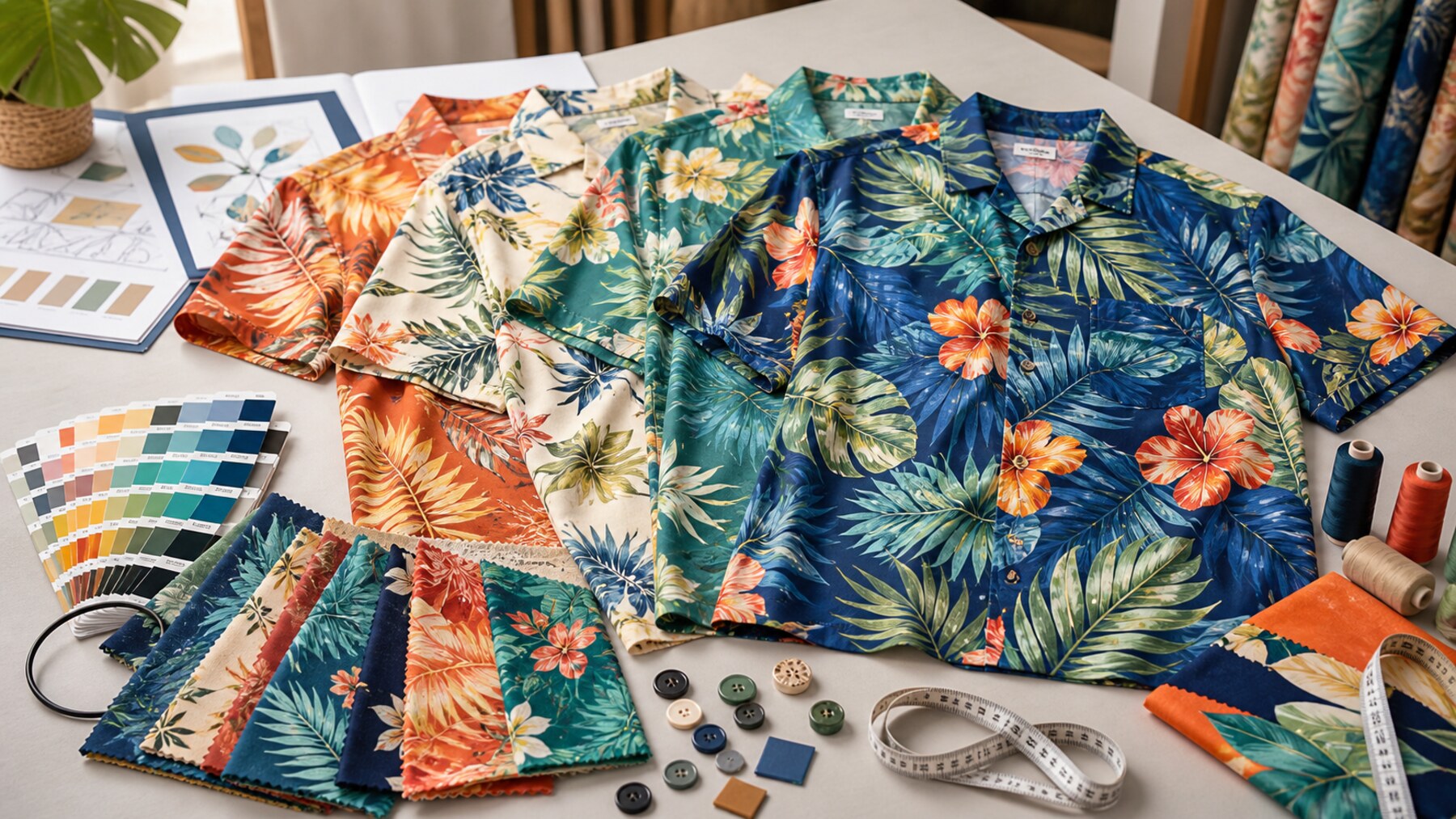
Summary. Buyers choosing extended-size rayon Hawaiian shirts should confirm fiber labeling, soft-handfeel approval, 3XL-plus measurements, wash dimensional change, print colorfastness, and current certification evidence before bulk production.
Key Takeaways
- Fiber claims need generic fiber names, percentages, rayon/viscose wording, and decoration disclosures for separate trims.
- Soft handfeel has no visible universal pass/fail threshold; approve against reference swatches or an AATCC EP5-style panel process.
- Extended-size specs need garment chest, shoulder, and length checks; one public rayon chart lists 3X chest 61.5 in and length 34.5 in.
- Wash approval should cover dimensional change in length and width plus accelerated laundering colorfastness before bulk production.
Direct Answer
Buyers should confirm five items before choosing custom rayon Hawaiian shirts for extended sizes: compliant rayon/viscose labeling, repeatable handfeel approval, graded 3XL-and-up measurements, finished-garment wash stability, and print colorfastness. Use supplier documents and sample tests; one public rayon benchmark lists 3X chest 61.5 in / 156 cm, 3X length 34.5 in / 87 cm, and 4X chest 65 in / 165 cm.
Confirm the Fiber Claim First
For custom rayon Hawaiian shirts for extended sizes, start with the material claim. FTC textile guidance uses examples such as 65% rayon / 35% polyester and Body: 100% Viscose / Ornamentation: 100% Silk, and notes that fiber-content percentages are calculated by fiber weight, excluding decoration. Before label approval, ask for generic fiber names, percentages, body fabric, pocket fabric, piping, labels, and ornamentation.
Do not let trade names replace fiber content. FTC bamboo-textile guidance says rayon or viscose is the same thing, and products made through that route should be described as rayon or viscose made from bamboo when bamboo is the plant source. Sellers are responsible for correct labeling and advertising, so keep supplier composition sheets, label artwork, and care-label text together.
Make Soft Handfeel Repeatable
A soft rayon handfeel is a buyer requirement, but the brief found no trustworthy public source with an industry-wide numeric threshold for rayon aloha shirts. Replace words such as buttery, silky, or premium with an approval method. AATCC EP5 - 2025 covers Fabric Hand Value with panel evaluation under repeatable conditions.
For custom aloha shirts, send the Hawaiian shirt manufacturer one approved reference swatch, one reject swatch if available, and a required review condition: washed or unwashed, steamed or unsteamed, flat table or hanger, dry indoor light, and named reviewers. The pass decision can be buyer-approved reference matching, not an invented softness number.
Benchmark the Extended-Size Spec
Extended sizes need a garment spec, not only a size label. The Two Palms men's rayon chart gives a useful public benchmark: 3X chest 61.5 in / 156 cm, 3X shoulder 26 in / 66 cm, 3X length 34.5 in / 87 cm, 4X chest 65 in / 165 cm, and 4X length 35 in / 89 cm. Treat that as one reference chart, not a universal rule.
Ask the aloha shirt manufacturer to show finished garment chest, shoulder, sleeve opening, bicep, hem sweep, center-back length, front length, pocket position, button spacing, collar size, and grade rules from 3XL upward. The brief found no authoritative public rule for relaxed-fit ease or minimum garment length in 3XL-and-up Hawaiian shirts, so the buyer should set these numbers before sampling.
Wash the Finished 3XL-Plus Sample
Rayon shirts can look right before laundering and still fail length or print expectations after washing. AATCC TM150-2025 covers dimensional changes of garments after home laundering, including length and width measurements, four washing temperatures, three agitation cycles, and four drying procedures. Run the test on finished 3XL-plus samples, not only fabric yardage.
Print color should be checked separately. AATCC TM61-2013e(2020)e2 is an accelerated laundering colorfastness method that represents five typical hand or home launderings in one 45 min test, using temperature, detergent solution, bleaching, and abrasive action. The brief found no accepted shrinkage or colorfastness tolerance specific to custom rayon Hawaiian shirts, so write the pass criteria into the sample approval sheet.
Check Certification Dates and MMCF Context
If a supplier uses material-safety or chemical-compliance language, check the certificate date and scope. OEKO-TEX published its 2026 regulation update on 03/03/2026, with new test criteria, limit values and requirements taking effect on June 1st, 2026 after a three-month transition period. Ask whether the certificate covers the exact fabric, print process, trims, and production facility for this order.
Rayon also belongs in a broader manmade cellulosic fiber file. TexData's Textile Exchange summary says global fiber production reached 132 million tonnes in 2024, up from 125 million tonnes in 2023, while manmade cellulosic fiber production rose from 7.9 million tonnes in 2023 to 8.4 million tonnes in 2024. The same pack lists MMCFs at a 6 percent share and viscose at 65-70 percent of total MMCF output. That scale makes traceable supplier documentation more useful than vague fabric names.
Send a Production-Ready Approval Pack
The RFQ should ask for a full extended-size approval pack: fiber-content worksheet, label artwork, buyer reference swatch, fabric-hand review method, 3XL-and-up graded spec, finished sample photos, wash-dimensional report, accelerated laundering colorfastness report, certification documents, and any known gaps marked (not visible). A sample can pass only when the buyer's written criteria are met.
Use /aloha-shirt-manufacturer as the internal planning path when comparing suppliers, then keep the commercial discussion separate from proof. A capable Hawaiian shirt manufacturer can help organize fabric, print, sample, and bulk-production questions, but the approval file still needs documents and tests tied to the exact order. Published by Aloha & Co, a resort wear, swimwear, and aloha shirt manufacturer.
Buyer Comparison
| Checkpoint | Evidence to request | Buyer decision |
|---|---|---|
| Fiber content | Generic fiber names and percentages, including 65% rayon / 35% polyester-style disclosure. | Approve label text. |
| Viscose or bamboo wording | Supplier documents using rayon or viscose, with bamboo source language only when supported. | Rewrite claims if needed. |
| Soft handfeel | Reference swatch or AATCC EP5-style panel review under duplicated conditions. | Approve the hand standard. |
| Extended size fit | 3X and 4X graded spec checked against public chest, shoulder, and length references. | Set ease and length. |
| Wash durability | TM150 length and width change plus TM61 accelerated laundering colorfastness. | Set pass criteria. |
| Certification currency | Date-valid certificate after the 2026 OEKO-TEX update and June 1st effective date. | Confirm scope and date. |
Buyer Questions
What should buyers confirm first?
Confirm generic rayon or viscose fiber names, fiber percentages, decoration disclosures, and label artwork before approving any custom aloha shirts.
Is rayon the same as viscose?
FTC bamboo-textile guidance says rayon or viscose is the same thing. Bamboo-source claims still need correct rayon or viscose labeling.
What is a reliable 3XL fit target?
A universal target is (not visible). One public rayon chart lists 3X chest 61.5 in, shoulder 26 in, and length 34.5 in.
How should buyers approve soft handfeel?
Use a buyer-approved reference swatch or AATCC EP5-style fabric-hand review. A universal rayon softness threshold is (not visible).
Which wash checks matter before bulk?
Request finished-garment dimensional change for length and width under TM150 and accelerated laundering colorfastness under TM61.
Sources
- https://www.ftc.gov/business-guidance/resources/threading-your-way-through-labeling-requirements-under-textile-wool-acts
- https://www.ftc.gov/bamboo-textiles
- https://www.oeko-tex.com/en/news/infocenter/oeko-tex-new-regulations-2026/
- https://www.texdata.com/news/Man-MadeFibers/22094.html
- https://members.aatcc.org/store/ep5/462/
- https://members.aatcc.org/store/tm150/556/
- https://members.aatcc.org/store/tm61/495/
- https://www.twopalms.jp/mens-rayon-size-chart