Private Label Adaptive Swimwear Manufacturer Guide
· Development · Aloha & Co Editorial Team
A buyer guide to co-design, accessible openings, sensory-conscious seams, secure coverage, swim testing, and adaptive prototype approval.
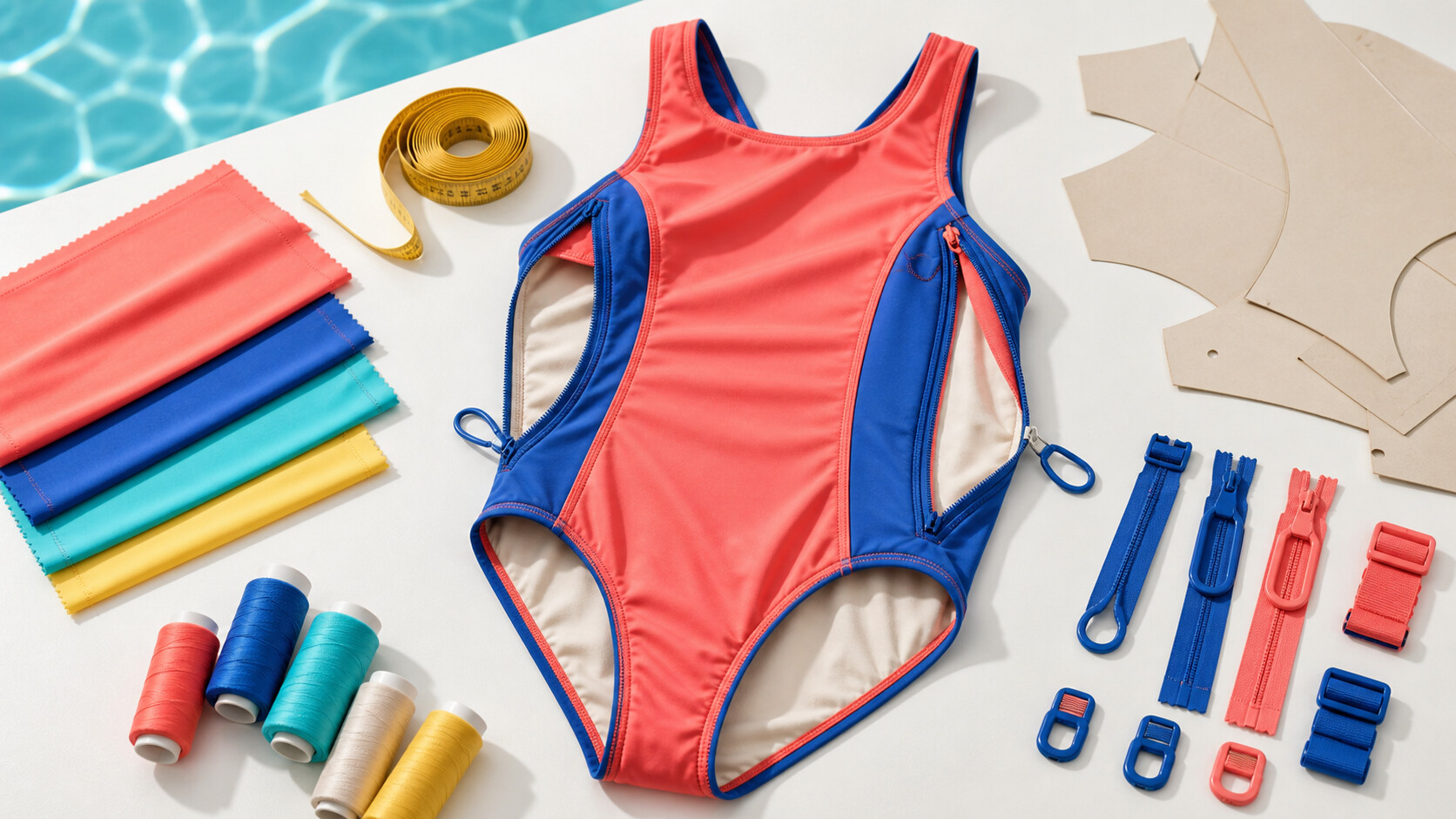
Summary. Buyers choosing a private label adaptive swimwear manufacturer should confirm disabled-user co-design, dressing access, seated fit, sensory details, secure coverage, chlorine colourfastness, and observed prototype wear tests.
Key Takeaways
- Make donning and doffing, seated fit, sensory comfort, coverage, and personal style measurable requirements rather than broad promises.
- Prototype openings and closures with disabled users and caregivers; no closure system is supported as universally suitable across disabilities.
- Specify ISO 105-E03:2010 chlorine colourfastness at the swimwear conditions of 50 mg/l and 100 mg/l active chlorine.
- Obtain written factory quotations because adaptive-swimwear MOQ, sampling charges, unit prices, tooling costs, and lead times are (not visible).
Direct Answer
Before choosing a private label adaptive swimwear manufacturer, confirm disabled-user co-design, easy on/off openings, accessible closures, seated fit, sensory-conscious seams, secure coverage, device or toileting access, and observed prototype wear tests. Require written fabric, colourfastness, sample, quotation, and acceptance details before bulk approval; private-label MOQ, pricing, lead time, and universal closure specifications are (not visible).
Start With Disabled-User Co-Design
A private label adaptive swimwear manufacturer should turn user needs into pattern, opening, closure, seam, and coverage decisions. In a co-designed white paper, Comfort and Fit led purchase motivators at 87%, followed by Price and Discounts at 72% and Functionality and Practicality at 69%, with N=102. Another 85% wanted clothing that was easy to wear and fashionable.
A mixed-methods study of female wheelchair users used a survey of n=160 and interviews with n=40. Donning and doffing ease was a highest priority for 98.8%, seated-posture fit for 96.2%, and social confidence for 98.1%. Ask how intended users will review access, seated fit, appearance, and dignity at sketch, prototype, and revision stages.
Translate Access Needs Into Construction
Write the dressing route before styling approval. Record the opening location, fastening operator, required grip, range-of-motion limits, and clearance for tubes, ostomies, prostheses, continence products, or other devices. Public examples show options, not a universal specification.
Primark's 2026 adaptive range includes a women's tankini with tube access at side seams and inner waistband pulls, and men's cargo swim shorts with accessible openings, device pockets, tube access, and inner waistband pulls. IZ Adaptive specifies two easy-grip side loops, easy-touch fly closures, a waist snap, and a liner for coverage and breathability. Another adaptive swimsuit uses crotch poppers for toileting, rear strap poppers for wet removal, and flatlock seams for sensitive skin. Confirm every feature against the target user's dressing sequence.
Test Closures, Seams, And Coverage
The co-design evidence recommends magnetic closures, larger zipper pulls, elasticated waistbands, flat or external seams, covered zips, and tag-less designs. These are prototype options. No closure works across all disabilities, and medical-device compatibility needs separate assessment. Comparative public data for holding force, accidental opening, corrosion, or grip after repeated contact with chlorine, salt water, and wet fabric are (not visible).
Define failure in user terms: a closure opens during transfer, a pull cannot be reached, a seam irritates skin, or coverage shifts during swimming and pool exit. One IZ Adaptive review reported that a magnetic button did not hold the waistband effectively. This is not comparative proof, but it supports testing closure security. Universal adult coverage criteria are (not visible), so acceptance must be co-defined.
Run Observed Prototype Wear Tests
Use observed dressing and undressing, not fit photos alone. A 2024 co-design protocol selected 10 wheelchair users with multiple sensory disabilities and evaluated on/off time, comfort, ergonomics, hygiene, and user or caregiver issues. It compared typical and adaptive clothing using observation and satisfaction questionnaires. Field notes and clothed non-identifiable media documented use.
A separate human-centred project revised its prototype after observing motor dynamics, then tested a second pattern and prototype. Its 127-response questionnaire found 77% reported limited information about adaptive clothing, 84% limited use, and 70% considered development extremely useful. Record assistance, time, reach, grip, wet removal, comfort, hygiene, and coverage, then revise and retest. A universal minimum participant count or disability mix is (not visible).
Lock The Factory Approval File
The custom swimwear manufacturer approval file should contain the user brief, dressing sequence, seated-fit requirements, access map, closure specification, seam and label details, device clearances, coverage zones, size range, and prototype comments. Adult adaptive size blocks for seated bodies, asymmetry, prostheses, ostomies, and wearable devices are (not visible), so buyers must supply program-specific requirements.
Add swim-specific material checks. ISO 105-E03:2010 covers colour fastness to chlorinated water; its 50 mg/l and 100 mg/l active chlorine conditions are intended for swimwear. Record fabric, lining, care route, test condition, result, and acceptance rule. For low MOQ swimwear, request MOQ basis, sample charges, prices, tooling, lead time, retest responsibility, and tolerances in writing because public adaptive private-label figures are (not visible). Published by Aloha & Co, a resort wear, swimwear, and aloha shirt manufacturer.
Buyer Comparison
| Checkpoint | Buyer confirmation | Evidence anchor |
|---|---|---|
| Co-design | Named disabled-user input at sketch, prototype, revision, and approval. | N=102 motivator study; n=160 survey and n=40 interviews |
| Dressing access | Opening route, operator, grip, reach, wet removal, and device clearance. | Primark, IZ Adaptive, and adaptive-swimsuit specifications |
| Sensory comfort | Flat or external seams, covered zips, tag route, and irritation notes. | Co-designed white paper |
| Coverage | Bust, seat, groin, stoma, lining, transfer, swim, and pool-exit criteria. | Buyer-defined; universal criteria (not visible) |
| Wear test | Observed on/off time, assistance, comfort, ergonomics, hygiene, and retest. | 2024 co-design protocol and iterative prototype study |
| Chlorine colourfastness | Test condition, result, and acceptance rule in the approval file. | ISO 105-E03:2010 at 50 mg/l and 100 mg/l |
Buyer Questions
What should buyers confirm first?
Confirm the intended users, dressing sequence, seated-fit needs, access points, coverage criteria, and how disabled users will participate in prototype review.
Which adaptive closure is best for swimwear?
No universal choice is supported. Magnetic, snap, hook-and-loop, and zipper systems require user-specific grip, security, wet-use, and device-compatibility testing.
How should adaptive swimwear prototypes be tested?
Observe dressing and undressing, assistance, reach, grip, seated fit, comfort, hygiene, coverage, wet removal, and closure security. Revise the pattern and repeat testing.
Which chlorine colourfastness reference applies?
ISO 105-E03:2010 lists 50 mg/l and 100 mg/l active chlorine conditions for swimwear. The buyer must still define the result and acceptance rule.
What MOQ should buyers expect?
Adaptive private-label MOQ, sample charges, unit prices, tooling costs, and production lead times are (not visible). Obtain a written, style-specific factory quotation.
Sources
- https://corporate.primark.com/en-gb/a/news/corporate-news/primark-launches-the-uk-high-streets-first-adaptive-swimwear
- https://adee.es/wp-content/uploads/2025/12/Tilting-the-Lens_Adaptive-Fashion-White-Paper_2025.pdf
- https://mail.msocialsciences.com/index.php/mjssh/article/download/3522/2376/
- https://www.iso.org/standard/52252.html
- https://www.proceedings.blucher.com.br/article-details/protocolo-de-coleta-de-dados-para-co-design-de-vesturio-adaptativo-voltado-a-usurios-com-deficincia-mltipla-sensorial-assistidos-durante-a-atividade-de-vestir-e-despir-39495
- https://openaccess-api.cms-conferences.org/articles/download/978-1-964867-35-9_51
- https://izadaptive.com/products/mens-pull-on-adaptive-swim-trunks
- https://adaptiveclothing.uk/products/adaptive-swimsuit-upf-rating-of-50