private label swimwear launch differentiation checklist
· Development · Aloha & Co Editorial Team
A buyer checklist for swimwear launches covering fit proof, fashion-performance fabrics, UPF labels, colorfastness, durability, and unsupported claims.
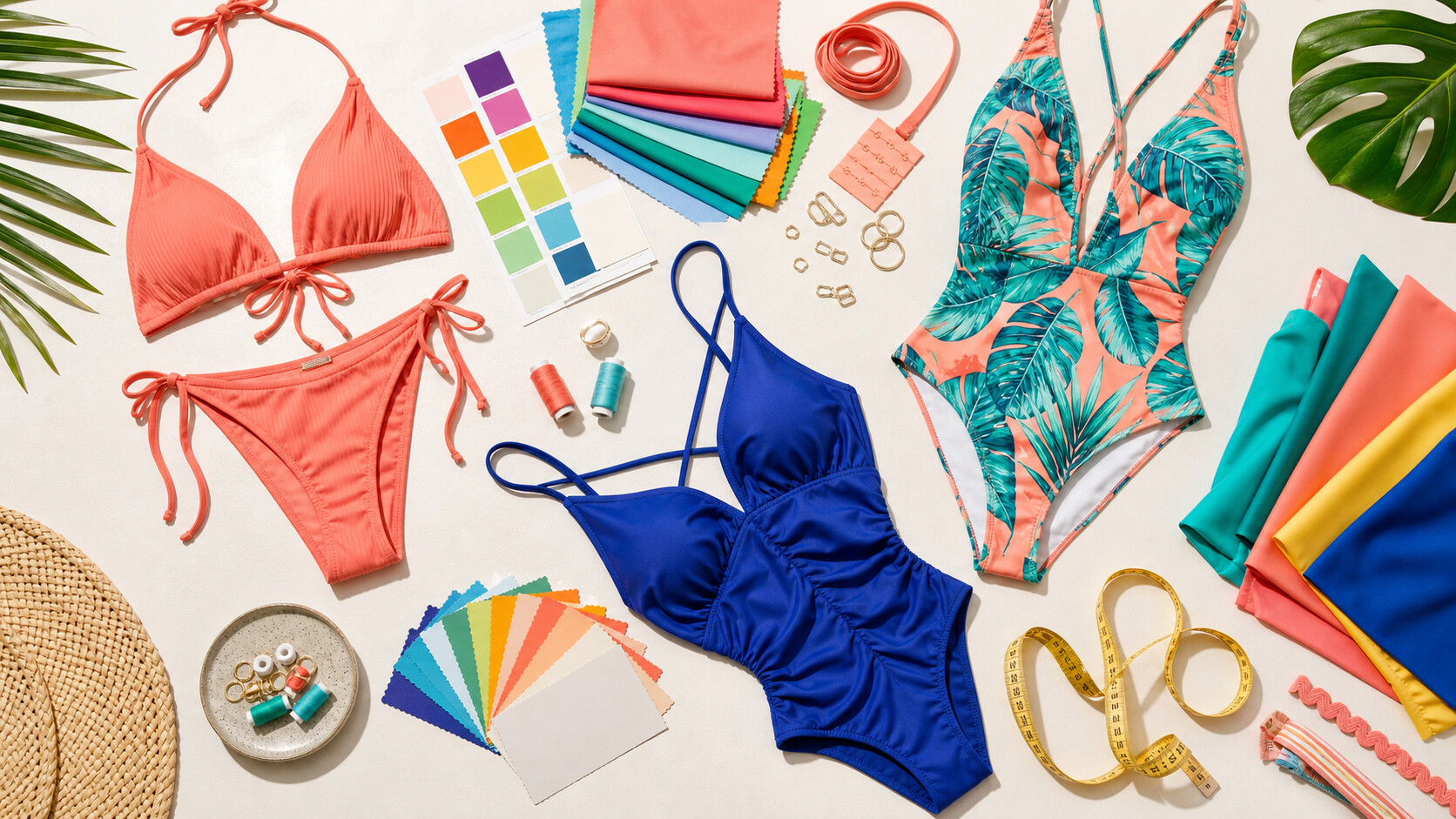
Summary. A growing swimwear market makes generic styling harder to defend. Buyers should validate fabric proof, UPF 50 claims, sea-water and chlorine colorfastness, elastane durability, fit specs, and claim gaps before private-label sampling.
Key Takeaways
- The swimwear market is projected from $24.1B in 2026 to $41.7B in 2035; launches need proof beyond trend styling.
- Treat recycled or performance-fabric claims as document checks: recycled polyester held 12% share in 2024.
- UPF 50 needs lab support: it blocks 98% of rays, and AATCC TM183 can test dry or wet specimens.
- Request sea-water and chlorinated-water tests before approving prints, linings, and trims.
Direct Answer
Buyers using a private label swimwear launch differentiation checklist should check market reason, fabric proof, UPF labeling, colorfastness, elastane durability, fit evidence, and unsupported claims before sampling. Key proof: UPF 50 blocks 98% of rays; AATCC TM183 tests dry or wet specimens; ISO 105-E02 covers sea-water colorfastness; universal premium fabric, fit, MOQ, or stretch-recovery thresholds are (not visible).
Start With a Real Launch Reason
A private label swimwear launch differentiation checklist should start with why the line deserves space, then move into sample proof. GM Insights puts the swimwear market at $22.9B in 2025, $24.1B in 2026, and $41.7B by 2035, a 6.3% CAGR from 2026 to 2035.
Bikinis produced around $9.1B in 2025 and are projected at 7.1% CAGR from 2026 to 2035. Online distribution held 82.4% of 2025 market share, and women's swimwear held 73.1%. Use those figures to choose a focused bikini story or broader women's capsule. For buyers, differentiation is a proof file, not a mood board. Published by Aloha & Co, a resort wear, swimwear, and aloha shirt manufacturer.
Verify Fashion Performance Fabrics
Fashion-performance fabric needs documentation, not just a handfeel note. Textile Exchange reports 132M tonnes of global fiber production in 2024, up from 125M in 2023, with 169M possible in 2030 if business continues as usual. Polyester was 59% of output, 88% fossil-based.
For recycled claims, the report lists 2024 polyester at about 78M tonnes, recycled polyester at 9.3M tonnes, recycled-polyester share at 12%, recycled fibers at 7.6%, and textile-to-textile recycled feedstock at less than 1% of the fiber market. If a custom swimwear manufacturer proposes recycled fabric, ask for composition, chain support, and mill evidence.
For durability, the Coolmax/LYCRA article identifies LYCRA lastingFIT, also called LYCRA XTRA LIFE fiber, for swimwear. It says the fiber resists sun, heat, chlorine, and lotion, lasts up to 10 times longer than unprotected fibers, and extending wear life by nine months can cut carbon, waste, and water footprints by 20% to 30% each. Treat these as supplier-specific claims to verify. A universal premium nylon/spandex or polyester/spandex threshold is (not visible).
Test Color Before Print Approval
Swimwear prints need ocean and pool checks before color approval. ISO 105-E02:2013 covers textile color resistance to sea-water immersion. It is Edition 5, published March 6, 2013, and was reviewed and confirmed in 2023.
QIMA describes a 1 to 5 colorfastness scale, Grade 5 highest and Grade 1 lowest. For ISO 105-E02:2013, it lists sodium chloride solution for 30 minutes, 12.5 kPa pressure, and a 37C oven for four hours. For ISO 105-E03:2010 chlorinated water, it lists 50 mg/l or 100 mg/l for swimwear and 20 mg/l for beach robes and towels. Approve shell, lining, print, and trims separately.
Separate Shape From Fit Proof
A new silhouette can help a rack or product page, but the cited data does not tie ombre, sequins, cut-outs, asymmetric straps, or any specific shape to measurable sell-through lift for new private-label swimwear brands. Treat those details as design hypotheses, not proof.
Fit still needs a buyer-owned spec. The cited data does not show a public premium-fit spec for bust support, torso length, cup size, seat coverage, movement tests, or stretch-recovery after chlorine exposure. Ask the private label swimwear manufacturer for sample size, size-set plan, lining, straps, support zones, hardware, coverage, and movement review, then write tech-pack acceptance criteria.
For the first sample, separate comfort notes from measurable checkpoints: strap length, elastic placement, coverage, cup or shelf-bra construction, lining opacity, and finished measurements by size. If the buyer cannot name the checkpoint, mark it (not visible).
Turn the Checklist Into an RFQ
Turn the checklist into an RFQ attachment before sampling. Ask for fabric composition, recycled proof if claimed, UPF method and label wording, sea-water and chlorine reports, elastane support, sample photos, fit notes, size-set status, trim details, care-label wording, and gaps marked (not visible). Map evidence to shell, lining, power mesh, elastic, stitching yarn, printed panels, hardware, and labels. One face-fabric report does not cover contrast lining or trims.
Keep low MOQ swimwear decisions narrow until proof improves. The cited data gives no defensible MOQ or target-cost benchmark for premium private-label swimwear by construction complexity, so supplier quotes or first-party costing are required. Use /private-label-swimwear-manufacturer as the planning path, then advance only shapes whose fabric, UPF, color, durability, and fit evidence can survive written review.
Buyer Comparison
| Checklist area | Evidence to request | Unsupported shortcut to reject |
|---|---|---|
| Market reason | Category, channel, and buyer target. | Trend styling alone. |
| Fabric claim | Composition, recycled support, mill data, durability notes. | Universal premium blend threshold. |
| UPF label | AATCC TM183 data; ASTM D6603 wording. | UPF hangtag without lab support. |
| Print color | ISO sea-water and chlorinated-water review. | Photo-only print approval. |
| Fit and shape | Size set, movement notes, support and coverage specs. | Universal premium-fit tolerance. |
| Low MOQ sampling | Sample scope, quote basis, buyer pass/fail rules. | Generic MOQ or target-cost benchmark. |
Buyer Questions
What should buyers check first in a swimwear launch checklist?
Check the market reason and proof file. The 2026 forecast is $24.1B, but differentiation still needs fabric, UPF, color, durability, and fit evidence.
Can one fabric blend define premium private label swimwear?
No. A universal premium fabric threshold is (not visible), so verify mill data and composition.
How should UPF 50 claims be validated?
Ask for lab data. UPF 50 blocks 98% of rays; AATCC TM183 can test dry or wet specimens.
Which colorfastness checks matter for swimwear?
Use sea-water and chlorinated-water checks, including ISO 105-E02 and 50 or 100 mg/l chlorinated-water levels for swimwear.
Are distinctive shapes enough for low MOQ swimwear differentiation?
No. Test shapes through samples, fit specs, fabric proof, and acceptance criteria.
Sources
- https://www.gminsights.com/industry-analysis/swimwear-market
- https://textileexchange.org/knowledge-center/reports/materials-market-report-2025/
- https://www.textileworld.com/textile-world/knitting-apparel/2025/08/upf-in-textiles/
- https://store.astm.org/workitem-wk95650
- https://members.aatcc.org/store/tm183/579/
- https://www.iso.org/standard/52231.html
- https://blog.qima.com/textile/colorfastness-test-methods-for-textiles-guide
- https://www.coolmax.com/en/business/news/discover-secret-durable-swimwear