A Private Label Swimwear Sunscreen Staining Test Checklist
· Development · Aloha & Co Editorial Team
A buyer checklist for testing sunscreen and body-oil marks on light swimwear shell and lining, including rinse, wash, and approval records.
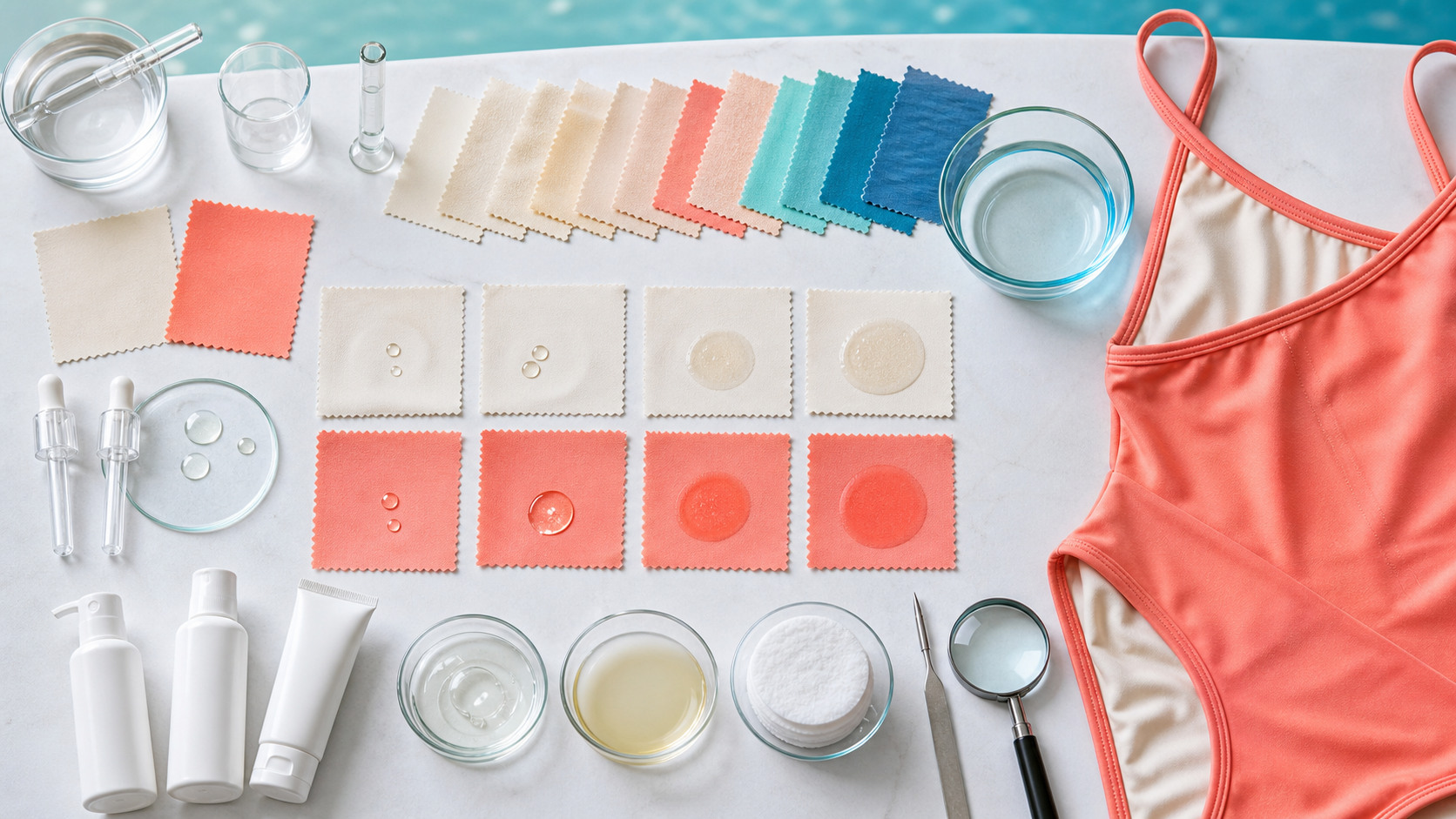
Summary. Use controlled swatch and finished-sample checks to document fresh sunscreen marks, cold-rinse results, wash-out performance, and color change before approving light-color swimwear for bulk production.
Key Takeaways
- Prewash control fabrics when the chosen method requires it, define the contact zone, and keep application, drying, rinsing, and washing conditions consistent.
- Test each light shell and lining combination separately because stain-removal results can vary with both textile substrate and cosmetic product.
- Judge the fresh contact mark and wash-out result; a stain that looks limited before washing may still leave measurable color change afterward.
- Set product-specific limits with the lab because a universal finished-swimwear sunscreen and body-oil method and universal pass/fail limit are not visible.
Direct Answer
A private label swimwear sunscreen staining test checklist should check light-color shell and lining separately, then repeat the contact test on the finished sample at likely sunscreen zones. Record the fresh mark, cold-rinse result, post-wash color change, wash-out performance, product-specific pass/fail limit, and validated care wording before bulk approval.
Define the Test Matrix Before Sampling
Start with the material combinations used in the style. List shell and lining colors, fiber blend, finish, print, trim, and representative sunscreen or body oil. Test light shell and lining separately, then together where the construction places them in contact.
Do not assume one lotion represents every risk. A 2024 cotton study compared woven and knit fabrics using an SPF 20 emulsion and an SPF 30 balm. Washing results depended on both substrate and cosmetic product, supporting a product-and-material matrix rather than one generic spot check.
Recent care guidance associates avobenzone, zinc oxide, and titanium dioxide with yellowish or oily marks. Use representative products from the intended market; the buyer should define formulas, doses, and product count because no standard formulation is visible.
Control Application, Contact, and Drying
Write the method before applying the product. Record specimen dimensions, product identity, dose, contact area, pressure, time, temperature, drying, rinsing, wash program, and wash count. No cited authority prescribes all conditions for finished private-label swimwear.
One washing study applied circular sunscreen patches 2 cm in diameter to 10 cm × 10 cm specimens and dried them at room temperature for 24 hours before washing. Use those exact figures only if the buyer and lab select that published study as a reference. They are not a universal swimwear protocol.
A Eurofins garment study cold-washed cotton T-shirts twice before testing, targeted sunscreen contact at the collar, and used five wear-and-wash cycles. This supports controlled prewashing, named contact zones, repeated exposure, and consistent washing, but is not a swimwear standard.
Check Swatches and the Finished Sample
Swatches help isolate material behavior. Place a light adjacent fabric or the actual light lining beside the shell so transfer can be assessed. ISO 105-A03:2019, Edition 5, describes the grey scale for determining staining of adjacent fabrics and gives a precise colorimetric specification. ISO reviewed and confirmed that edition in 2025.
Swatch approval is not enough for bulk release. Test the finished sample at likely contact zones. Photograph seams, elastics, trims, and shell-to-lining areas before contact, after contact, after cold rinse, and after washing. Retain both swatch and garment stages in the approval file.
For low MOQ swimwear, use production-intent shell, lining, elastic, thread, and trims. Review any material substitution after approval.
Record Fresh Staining and Wash-Out
Assess two outcomes: how strongly the product stains the textile and how well the mark washes out. BASF states that its staining test was developed to examine both. A fresh-contact photograph alone therefore does not complete the buyer review.
Create records at initial contact, after cold rinse, and after the specified wash cycle. Eurofins records garment color initially at t=0 and finally at t=1, compares the values, calculates change in L*a*b*, and documents each color component separately. Use the lab's agreed instrument and method rather than inventing a universal delta limit.
The cotton study tested washing from 20 °C to 90 °C and measured removal by remission spectrophotometry. Swimwear care may require a narrower condition. Test the intended care route; record other temperatures only for a defined development question.
Add Relevant Colorfastness Checks
A sunscreen contact check does not replace adjacent colorfastness work. Intertek lists ISO 105-C06 or AATCC 61 for washing, ISO 105-X12 or AATCC 8 for wet and dry rubbing, and ISO 105-E04 or AATCC 15 for acidic and alkaline simulated perspiration.
For beachwear exposure, Intertek lists ISO 105-E03 for chlorinated water, ISO 105-E02 for seawater, and AATCC 106. Select tests that match the product's intended use and destination requirements. Keep their results separate from the custom sunscreen and body-oil contact result so a passing standard colorfastness report is not misread as sunscreen-stain approval.
Lock Approval Rules and Care Wording
The approval sheet should name tested materials and products, method revision, contact zones, images, readings, rinse and wash conditions, and the buyer's decision. AATCC notes that standardized assessments can verify textile performance against customer expectations. Repeatability makes the release condition auditable.
A universal pass/fail limit for sunscreen staining on light swimwear is not visible. Agree product-specific visual or colorimetric limits with the lab before testing and state whether the limit applies after contact, rinse, wash, or all three. Likewise, mandatory wording that guarantees stain prevention or removal is not visible. Keep the care label consistent with validated garment testing and applicable market labeling rules.
Buyer Comparison
| Checkpoint | Evidence to record | Approval rule |
|---|---|---|
| Shell and lining | Each light substrate and combination | No material substitution without review |
| Contact method | Product, dose, area, pressure, time, drying | Use one written method revision |
| Fresh mark | Photo and agreed visual or instrument reading | Apply buyer-defined limit |
| Cold rinse | Photo and remaining color or oily mark | Record before washing |
| Post-wash | Wash conditions and L*a*b* or grey-scale record | Apply product-specific wash-out limit |
| Finished sample | Seams, elastic, trims, shell-to-lining zones | Confirm before bulk approval |
Buyer Questions
Is there one standard sunscreen staining test for finished swimwear?
No universal combined sunscreen-and-body-oil method is visible. Buyers and labs should document a product-specific method.
Should buyers test both shell and lining?
Yes. Test each light shell and lining separately, then confirm the combination on the finished sample.
What exact specimen setup can inform a development trial?
One study used 2 cm patches on 10 cm × 10 cm specimens with 24 hours of room-temperature drying. It is not a universal swimwear method.
How should post-wash color change be recorded?
Use an agreed visual or instrumental method. Available models include ISO 105-A03 adjacent-fabric staining assessment and before-and-after L*a*b* records with each component documented.
What pass/fail limit should a buyer use?
A universal limit is not visible. Set product-specific limits with the lab before testing and state which stage each limit covers: contact, cold rinse, wash, or all three.
Can care wording guarantee sunscreen stain removal?
No authoritative mandatory wording that guarantees prevention or removal is visible. Use wording consistent with validated garment testing and applicable labeling rules.
Sources
- https://cdnmedia.eurofins.com/apac/media/601404/garment-staining.pdf
- https://care360.basf.com/emea/en/industries/personal-care/core-competencies/all-about-sun/sun-protection/about-claims
- https://www.intertek.com/textiles-apparel/colorfastness-testing/
- https://www.iso.org/standard/75985.html
- https://hrcak.srce.hr/clanak/490153
- https://www.aatcc.org/news-read/insights/aatccs-textile-testing-demonstration-is-back-for-functional-fabric-fair-spring
- https://bondiwash.eu/en-fr/blogs/news/how-to-remove-sunscreen-stains-from-swimwear-naturally