Buyer’s Private Label Swimwear Tech Pack Checklist
· Development · Aloha & Co Editorial Team
A buyer-ready checklist for swimwear flats, BOM, seams, lining, elastic, measurements, artwork, labels, packaging, and sample approvals.
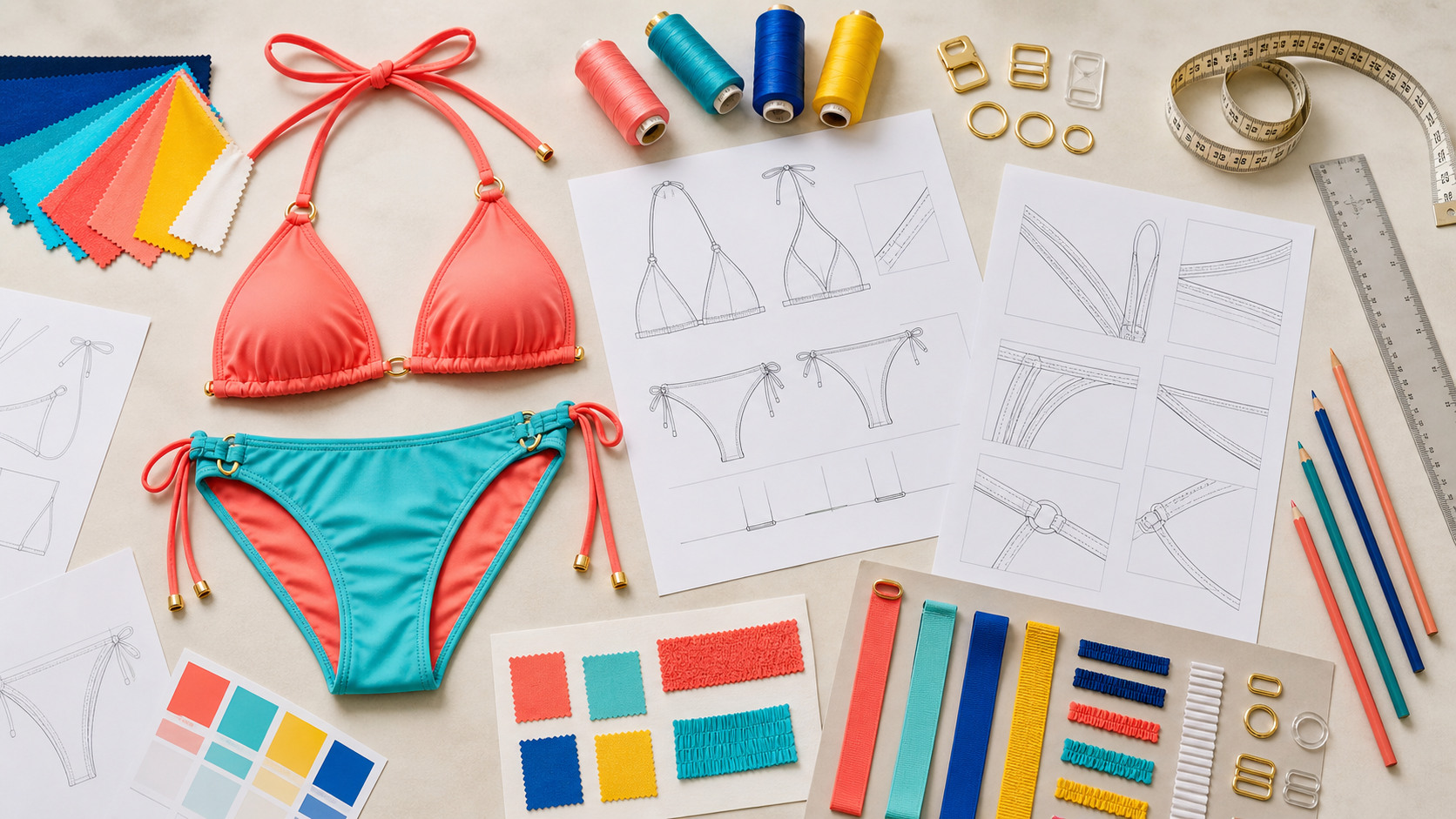
Summary. Use this private label swimwear tech pack checklist to close interpretation gaps before quoting and sampling. Check flats, BOM, construction, lining, elastic, measurements, tolerances, colorways, artwork, labels, packaging, and open approvals.
Key Takeaways
- Sketches need technical flats and written construction callouts; recent public buyer discussions describe factories missing the intended concept or look when given sketches alone.
- A complete BOM identifies shell, lining, elastic, sewing yarn, hardware, labels, and packaging rather than leaving components to factory interpretation.
- Record measurements and style-specific tolerances, but do not copy one universal POM list or tolerance across fabrics, support structures, and size ranges.
- Separate first-sample inputs from later bulk controls by asking the supplier when grading, AQL, pre-production approval, testing, and packaging details become mandatory.
Direct Answer
A private label swimwear tech pack checklist should define the product well enough for a factory to quote and sample without guessing. Check technical flats, BOM, fabric and lining, elastic, seam and stitch construction, measurements and tolerances, colorways, artwork, labels, packaging, plus every unresolved approval question.
Start With A Factory-Readable Product Definition
Begin with front and back technical flats, not a mood board or sketch alone. Show seam lines, panels, closures, straps, cups, hardware, lining zones, and interior construction that affects the quote. Label each view so every callout maps to the correct garment area.
Recent buyer discussions show the risk: manufacturers may not understand the intended concept or look from sketches alone. Buyers need to translate appearance, construction, and approval decisions clearly before sampling starts.
Build The BOM And Material Map
List each physical component in the BOM: shell, lining, interlining, zips, hardware, labels, elastic, sewing yarn, and packaging. Map items to placements such as the gusset, cup pocket, underbust, leg opening, strap, or closure. Record the reference, specification, color, quantity basis, and approval status. Mark unresolved fields instead of inserting defaults.
Also define four-way stretch behavior, elastic recovery, Framilon tape, cups, underwire, compression, and saltwater durability. Fabric composition, GSM, stretch, recovery, opacity, elastic width, and sewing ratio have no universal values; approve them against the chosen material, pattern, support, and fit sample.
Name Seams, Stitches, And Elastic Construction
Name the seam type, stitch type and count, seam allowance, and topstitch distance. ISO 4915:1991 classifies and illustrates stitch types and was confirmed in 2021. Standard designations are clearer than phrases such as ‘stretch stitch’ or ‘clean finish.’
Map elastic placement on the flats. Openings and support areas may need different construction, with no universal tension ratio. Ask the factory to specify the elastic, attachment, turnback or binding, and sample evaluation method. Apply the same detail to cups, underwire channels, Framilon, compression panels, lining joins, and hardware.
Control Measurements, Tolerances, And Grading
Create a point-of-measure table with a numbered diagram, base size, measurement method, target value, unit, and tolerance. One current checklist uses ±0.5 cm as an example, but the evidence does not support that value as a universal swimwear tolerance. Set tolerances by style, fabric stretch and recovery, support construction, size range, measurement repeatability, and the agreement with the factory.
State whether the request covers a quote, prototype, fit sample, size set, or bulk approval. Ask which measurements are quote inputs, when full grading is required, who owns pattern corrections, and how fitting revisions are recorded. Even low MOQ swimwear needs an agreed approval record.
Lock Color, Artwork, Labels, And Packaging
Give each colorway a code and connect it to shell, lining, elastic, sewing yarn, hardware, labels, and artwork. For prints, include the file version, scale, orientation, repeat, placement, and approved color reference. Confirm placement and repeat tolerances plus the color-approval method with the supplier.
Resolve label content before artwork approval. For most textile and wool products in the United States, the FTC says labels must list fiber content, country of origin, and the manufacturer or another responsible business. The Care Labeling Rule requires manufacturers and importers to provide cleaning instructions. Confirm the sales market, responsible party, wording, label type, placement, and care instruction with the appropriate compliance owner. Packaging also needs channel-specific decisions on folding, individual bags, warnings, barcodes, carton quantities, and retailer or e-commerce requirements because no universal packaging specification was established.
Turn Open Questions Into Sample Approvals
End the pack with an approval register. Assign an owner and status to fit, coverage, lining, opacity, elastic recovery, cup support, hardware, color, print placement, labels, packaging, and test requirements. If pool-water colorfastness matters, ISO 105-E03:2010 provides three alternative conditions; 50 mg/l and 100 mg/l active chlorine are intended for swimwear, while 20 mg/l is intended for accessories such as beach robes and towels. Name the required condition and acceptance decision rather than writing only ‘chlorine resistant.’
ASTM D2594-20 measures stretch under load and growth after extension. ASTM cautions against using it for commercial-shipment acceptance because between-laboratory precision is poor. Use it to frame an agreed evaluation, not a universal shipment rule. Clear revision notes reduce interpretation loops, but buyer and supplier must agree on fees, timing, and approval stages.
Before sending the file, remove blank assumptions and mark unresolved fields as ‘approval required’ or ‘not visible.’ Published by Aloha & Co, a resort wear, swimwear, and aloha shirt manufacturer.
Buyer Comparison
| Checkpoint | Pack must show | Buyer must confirm |
|---|---|---|
| Flats | Front, back, interior, panels, closures, hardware | Every callout maps to a view |
| BOM | Shell, lining, elastic, thread, hardware, labels, packaging | Reference, color, placement, approval status |
| Construction | Seam, stitch, count, allowance, topstitch distance | Standard designation and sample method |
| Measurements | POM diagram, base size, method, value, unit, tolerance | Style-specific tolerance and grading stage |
| Color and print | Colorway codes, artwork version, scale, repeat, placement | Supplier-specific tolerances and approval reference |
| Compliance | Fiber, origin, responsible business, care instructions | Market, wording, label type, and placement |
| Sample approval | Fit, opacity, support, recovery, color, labels, packaging | Owner, test method, stage, status, and next action |
Buyer Questions
Are sketches enough for a swimwear sample?
Public buyer discussions describe factories missing concepts or intended looks from sketches alone. Add technical flats, construction callouts, BOM, measurements, and approval questions.
What belongs in a swimwear BOM?
List shell, lining, elastic, sewing yarn, hardware, labels, and packaging, then connect each component to its placement, color, reference, and approval status.
Should every swimwear style use a ±0.5 cm tolerance?
No universal value was established. ±0.5 cm is one checklist example; agree tolerances by style, material behavior, support construction, size range, and measurement method.
Are AQL and full grading required for the first sample?
The evidence does not establish one rule. Ask the supplier which controls are needed for quoting, the first prototype, size-set approval, pre-production approval, and bulk production.
Which swimwear tests should the tech pack name?
Name only tests relevant to the product and market. The pack supports discussing ISO 105-E03 for chlorinated-water colorfastness and ASTM D2594-20 for stretch and growth, with ASTM’s stated acceptance-testing caution.
What should remain open before the quote?
Mark unresolved fabric, elastic, fit, grading, artwork, testing, label, and packaging decisions. Ask the factory which items affect price and which can wait for sampling.
Sources
- https://www.reddit.com/r/ClothingStartups/comments/1uk3ti0/anyone_else_struggle_finding_a_swimwear/
- https://www.reddit.com/r/ClothingStartups/comments/1sm7szj/could_someone_tell_me_if_this_techpack_is_enough/
- https://www.techpackmarket.com/blog/tech-pack-checklist
- https://thelondonpatterncutter.co.uk/swimwear-tech-pack/
- https://www.iso.org/standard/10932.html?browse=tc
- https://www.iso.org/es/contents/data/standard/05/22/52252.html
- https://store.astm.org/d2594-20.html
- https://www.ftc.gov/news-events/topics/tools-consumers/apparel-labeling